
The Windshield Flâneur
By William Riera
July 28, 2026
It was Sunday morning when I woke up wanting to get out of the house, hoping to shoot some images. I started driving with no clear destination, and before I knew it, I was on a road trip. Then, out of the corner of my eye, I saw something — something that disappeared before I could identify what it was — and slammed on the brakes before my brain had finished the thought. I parked. Got out. Walked back to look. It's happened enough times that I'm not surprised when it does: driving along at forty, fifty, sixty miles per hour, some other part of me still reading the landscape the way another person might scan a room, searching for the phrase made only of light, the image active but already disappearing.
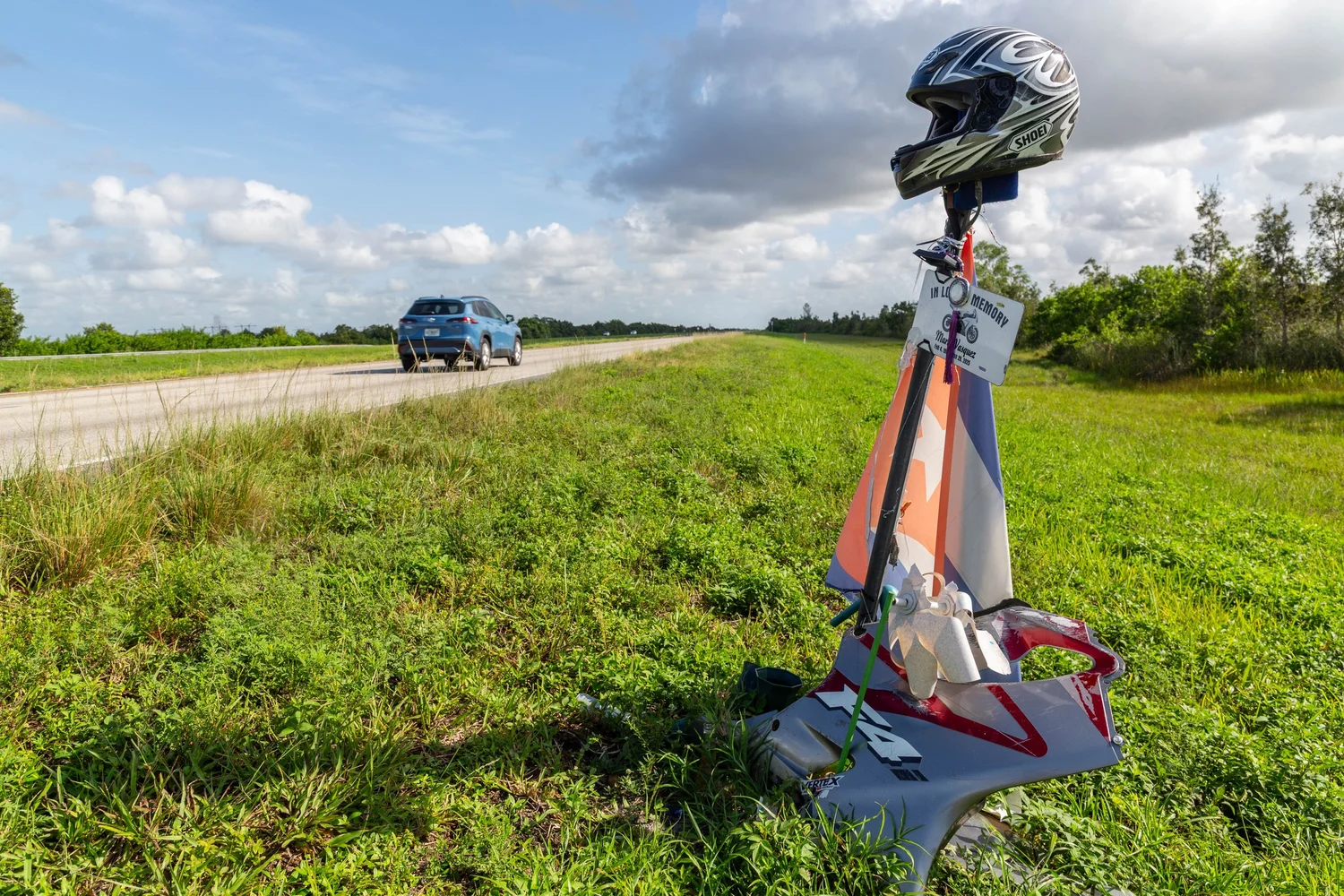
I've called myself a flâneur since I first got serious about street photography and learned what the word meant. It fit. But I've never been fully comfortable applying it to the way I actually work in Miami, the city I call home and where I've spent most of my adult life. Miami is not a city where walking is optional. Public transportation here is unreliable at best, and nothing about the way the city is governed suggests that will change soon. You can walk in Downtown, in Miami Beach, in Wynwood — the postcard neighborhoods, the ones built for foot traffic and tourist dollars. But step into most residential streets and a person walking alone reads less like a flâneur and more like an anomaly, someone who probably needs a ride.
That identity goes back further than Miami, though. I found photography around the turn of the century, when I started studying it seriously in college, and it became the clearest way I had of talking to the world and understanding the people in it. Looking back, it wasn't really a new impulse — I'd been a collector since I was a teenager, stamps and coins, the same instinct for gathering fragments of the world and arranging them into some kind of sense. Photography just gave that instinct a body to move through space with, instead of a drawer to keep it in.
The moving came first, actually, before the camera did. When I left my hometown of Santiago de Cuba for Havana as a young man, I learned the capital by getting lost in it on purpose, riding the bus lines back and forth with no destination, just to see what the city would show me. That was flânerie before I had the word for it — public transportation as a form of entertainment, discovery disguised as commuting. When I arrived in Miami in 1995, I kept doing exactly that: learning the city by moving through it, first by bus, then, once it became clear that Miami wasn't built for anyone without a car, by driving.
I studied photography in black and white, on film, and I stayed loyal to it — skeptical of digital well after everyone around me had moved on, not converting until around 2004, and even then reluctantly, still finding excuses to get back into a darkroom. It took another decade after that before any of it became public in a serious way: my first solo exhibition opened in 2014, and it cracked open a version of my practice I hadn't let myself see before. Almost everything I've mentioned so far comes out of that opening. Before 2014 there's a great deal of street work I never organized into a series, mostly made on trips, still living in boxes and hard drives rather than on a website. But it was there the whole time. The instinct never took a year off. Only the audience for it changed.
The clearest evidence of that connected decade is Altares Urbanos, a series I made between 2015 and 2020 of the shrines Miami's Hispanic families built on their own lawns, sidewalks, and storefronts — a saint standing sentry in a jewelry store window between a Cartier sign and a Rolex sign, faith doing quiet business alongside commerce. I found almost all of it on foot, walking Little Havana, Wynwood, Downtown, block by block, the same way I'd once ridden buses through Havana looking for nothing in particular and finding everything. The shrines were never hard to see once I was walking slowly enough to notice them. That's the whole method in one sentence, years before I needed a better one.
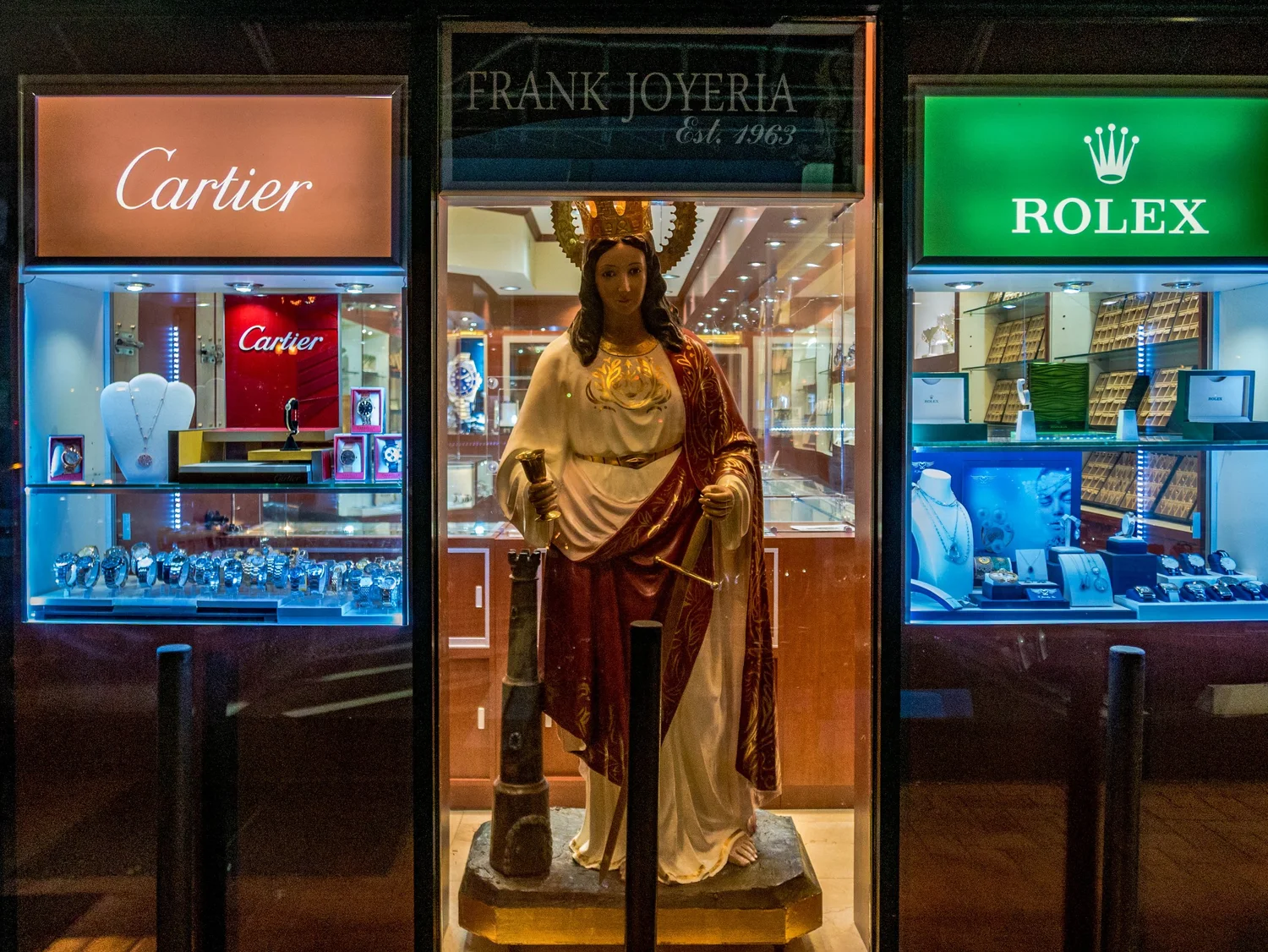
There was a version of Miami where this mattered less, because I still walked the neighborhoods that mattered to me. Downtown, Little Havana, Coconut Grove, Wynwood — for years these were places where locals like me spent an ordinary Friday night, not attractions so much as extensions of home. That's mostly gone now. Rising prices and a wave of tourism have pushed most of us out of the places we used to claim as ours, and gentrification keeps eating whatever was left of the corners that told the story of how this city came to be. Miami was never an old city, never particularly rich in the kind of architecture or history that resists erasure — and developers have never given much indication that they care to preserve what little of it exists. I walked around Downtown recently and barely recognized it. The corners I used to look for, the ones I built whole projects around, are practically gone.
So my relationship with this city — my home — has changed, and with it, my practice. My method itself hasn't: it has always been a drive-and-walk process, get in the car, find a scene, get out, shoot. But I used to walk more of these neighborhoods, and now I rarely do, because I can't always find the connection that used to pull me out of the car. Some days I take my camera, or just my phone, and come home having shot nothing at all. It's only now, faced with that silence, that I feel a real need to reclaim the term — to find language that actually describes what I do instead of quietly retiring the word “flâneur” because it no longer fits cleanly.
I don't think I'm alone in this, either. In conversations with other photographers working these same streets — some of them decades into it, some newer — I keep hearing versions of the same reckoning: the sense that the city they built a practice around has kept moving without them, that the blocks worth walking have shrunk or turned into something to be consumed rather than lived in, that the car has gone from tool to wall. Not everyone reaches for the word flâneur to describe what they've lost. But enough of them recognize the shape of it that I don't think this is just a private complaint anymore. It might be closer to a diagnosis of what it now takes to keep making street pictures in a place like this.
Most of my Miami projects never started as ideas. I'd wake up, grab the camera, drive, and start shooting whatever scene I connected with — the project would arrive afterward, as a way of making sense of images I'd already taken. That's the tradition I come out of, the one American photography has always trafficked in: road trips, road scenes, joy rides, wanderings, voyages of discovery. The critic David Campany traces this lineage in The Open Road: Photography and the American Road Trip, from Robert Frank's zigzagging 1955 journey for The Americans to Ed Ruscha's deadpan gas stations to Stephen Shore, who once said simply that the country itself was “made for long trips.” Going back through that book, what strikes me is how little some of these photographers needed to leave the vehicle at all. Shinya Fujiwara spent seven months criss-crossing the country in a motor home for a series he called American Roulette, working from inside it more than out. The windshield wasn't a compromise for him. It was where the picture happened to be. So when I say I've always been on the road, moving, migrating, that's not just my story — it's a story with a visual history behind it, one I only found the name for after I'd already been living inside it for years.
What that same tradition warns against is the open road hardening into what Campany calls “ridged mythology” — Route 66 nostalgia, recycled ad nauseam, a fixed fantasy stuck in the past. That isn't this. Nobody drives the Palmetto or Krome Avenue chasing a postcard. My road trips don't end anywhere; there's no Promised Land waiting at the end of the Dolphin Expressway, just the drive home and the drive back out again tomorrow. Whatever this is, it's smaller than myth and more stubborn than myth. I refuse to accept Miami's streets as a desert for that thirst anyway. But I'd be lying if I said I wasn't asking, more than I used to: will Miami, will Florida, keep being the open road my photographic life has depended on?
One project made this literal. In 2022, in my twenty-seventh year living in this country, I turned Highway 27 into the spine of a body of work I called Highway 27: In Search of My Eudaimonia. The road begins in Miami and runs north through Florida's rural interior until it ends, of all places, in a town called Havana, a few miles from the Georgia line. My mother had died the year before, and the coincidence of that name — one Havana remembered, one geographically encountered — turned a highway into an instrument instead of a metaphor. I didn't want the drive to read as myth, another version of the escape or discovery Campany's photographers were after. I wanted it as meditation: movement as a way of measuring who I was becoming, not what I was running toward or away from. The horizon worked as a threshold. Distance worked as a unit of feeling. That project is the clearest proof I have that the windshield register isn't just a way of grabbing a picture in passing — it can carry an entire body of work, start to finish, without my feet touching the ground until I chose to stop them.
That question sent me back to the source. Baudelaire's flâneur. Walter Benjamin's flâneur. The gentleman who wanders the city without destination or urgency, reading the street like a text, able to do that reading because he walks — slow enough to notice, aimless enough to be surprised, close enough to the ground to catch what would blur past at speed. There's something lovely in it, and less and less of it describes my life here. Even in the neighborhoods where walking is possible, I'm rarely walking without a reason anymore, and in most of the city, walking was never really the option it's romanticized to be. Behind glass is where the looking mostly happens now.
For a while I treated that as a disqualification — as if losing the sidewalks, or losing my reason to be on them, meant forfeiting the practice itself, as if paying attention only counted if my legs were the ones in motion. But I kept noticing things anyway. Stucco walls bleached a particular white that will never happen quite that way again. A single figure crossing an empty parking lot at noon. Palm shadow doing its slow stutter down a chain-link fence. None of that stopped me from looking. It just changed how the looking got done. And I learned that this changed condition had a history of its own, one I hadn't been the first to notice.
The architecture critic Reyner Banham argued, driving around Los Angeles in 1971, that freeway systems produced a “special state of awareness” in the people who used them regularly, and that you couldn't write honestly about a city like that unless you learned to drive its roads yourself — that reading it was something you couldn't do from a distance. Geographers who study American road culture have a name for what I'd been circling: windshield geography, the reading of landscape through the glass of a moving car, comprehended in slices, in the shallow depth of field you get right before you finally slow down and pull over. None of this is flânerie by any familiar definition. But it isn't nothing, either.
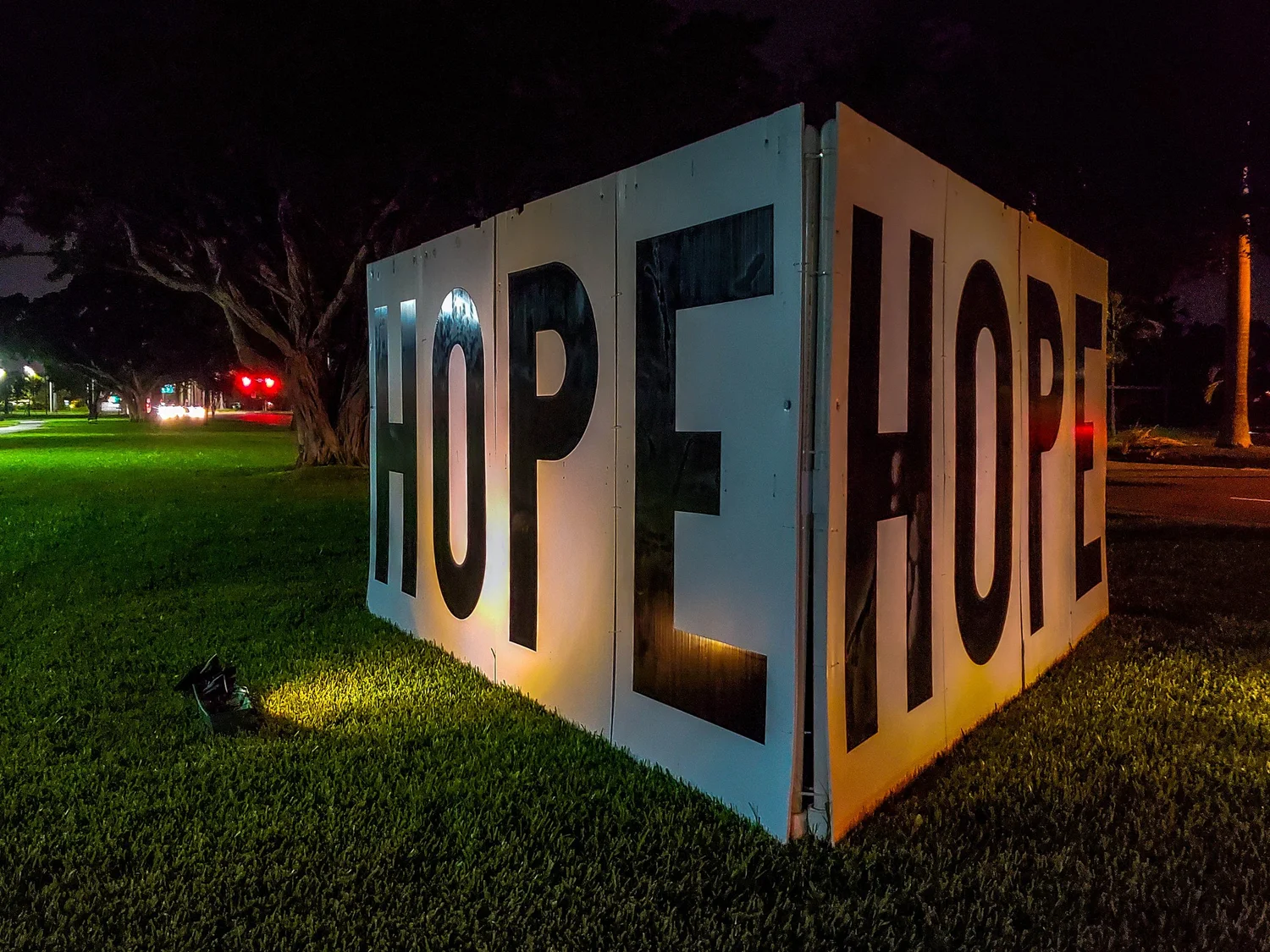
Five years before I had a name for any of it, I was already doing it. During the COVID lockdowns, starved for a reason to leave the house, I started taking nocturnal drives through a Miami that had gone empty — modern lighting spilling over deserted streets, whole business strips dark, the city seemingly asleep at eight o'clock. I drove slowly and stopped whenever something asked me to, photographing corners of the city nobody puts on a postcard: a giant lit-up HOPE sign leaning on an empty lawn, taillights bleeding red into the dark behind it. I called the project Miami Urban Silence in Times of Covid-19 and didn't think much about the method behind it at the time. Reading my own notes on it now, I recognize a sentence I could have written yesterday: driving slowly, pausing whenever a scene beckoned. The windshield flâneur was already working. I just hadn't caught up to naming him yet.
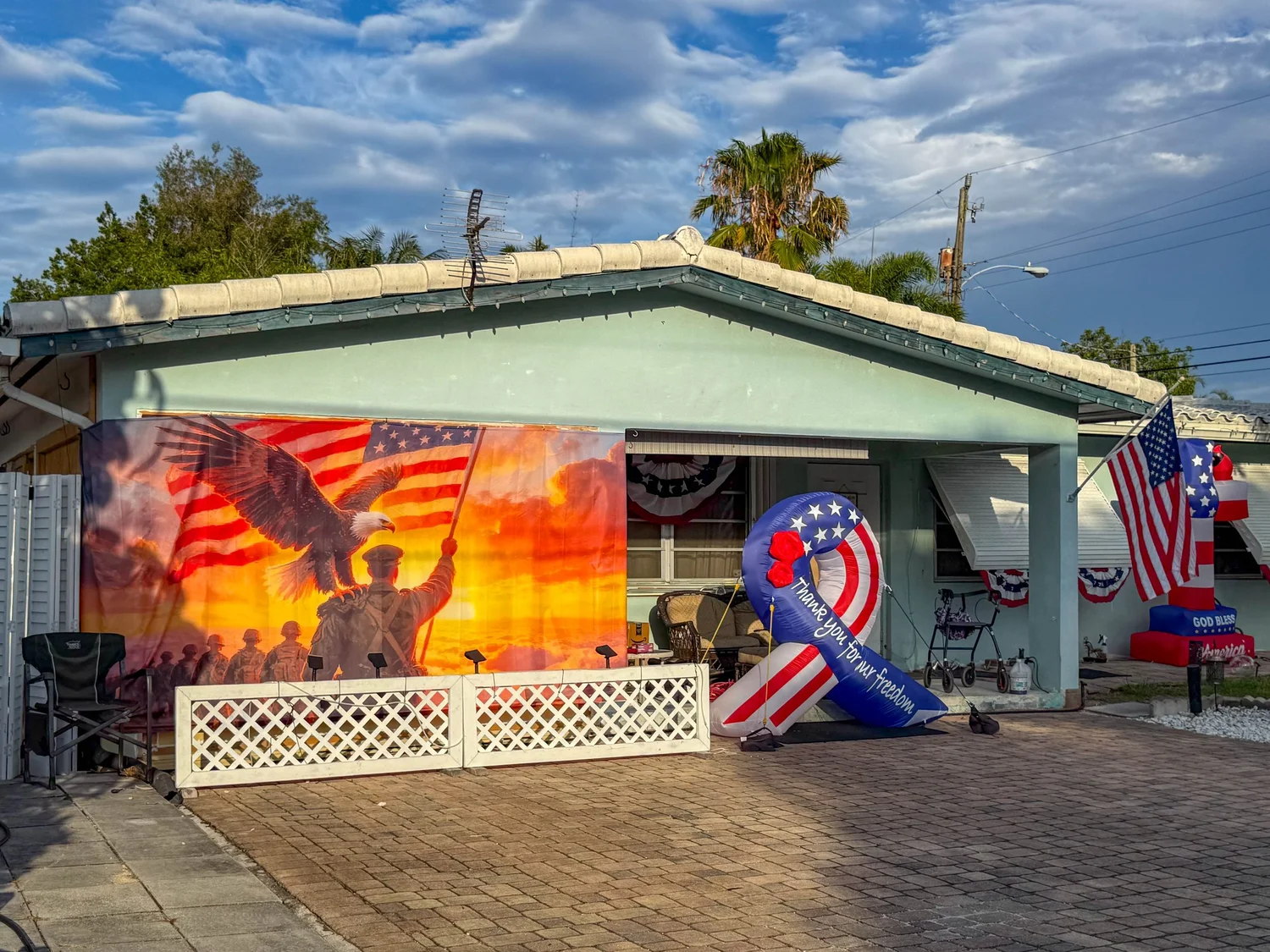
These days I call myself the windshield flâneur, and the longer I sit with the term, the less it feels like a compromise and the more it feels like an accurate description of a practice with two parts, neither of which works without the other. The first is the drive itself — eyes sweeping the landscape passing outside the window, the windshield already framing the image before I've decided I want to keep looking. Some photographs live entirely in this register: shot through glass, through the window of a moving car, the car becoming part of what's being seen instead of something to shoot around. The reflections. The way the world streaks at the edges. A dirty windshield. Glare crossing the glass as the car turns. All of it stays in the frame because all of it is proof of how the image was found — proof, too, of a city that made the car necessary before it ever made the sidewalk possible. That's how I got a photograph of a house near Oakland Park last summer — a yard done up in full patriotic regalia, flags and bunting and an inflatable eagle, the kind of thing you only really register at forty miles an hour with the light already starting to leave. I didn't plan the shot. I drove by, the light was doing something I couldn't ignore, and I was already reaching for the camera before I'd finished deciding to slow down.
The second register only shows up sometimes, and it's the part that still resembles the original flâneur. Something vivid or strange or still catches me, and I pull over — not always legally, not always practically — and get out and walk back toward whatever it was. That's when the windshield falls away, and I'm a pedestrian again: close, slow, looking the way anyone has ever looked at a city on foot. The photograph taken after I've parked is a different object than the one shot through glass. It has no frame inside the frame. I stood to take this picture.
There's a house in Sweetwater, painted the specific saturated blue that stops me every time, that I must have driven past many times over the years — always blocked, always moving, never any reason to stop. Then one weekend the gate was open, and no car was blocking the view. I parked, walked up, and got the picture: a wicker peacock chair by the door, a human-size doll draped in blue lace sitting in it, watching the street the way I'd been watching the house. Whatever was looking out met whatever was looking in. A hundred windshield passes had been rehearsal for the one time I finally stopped.
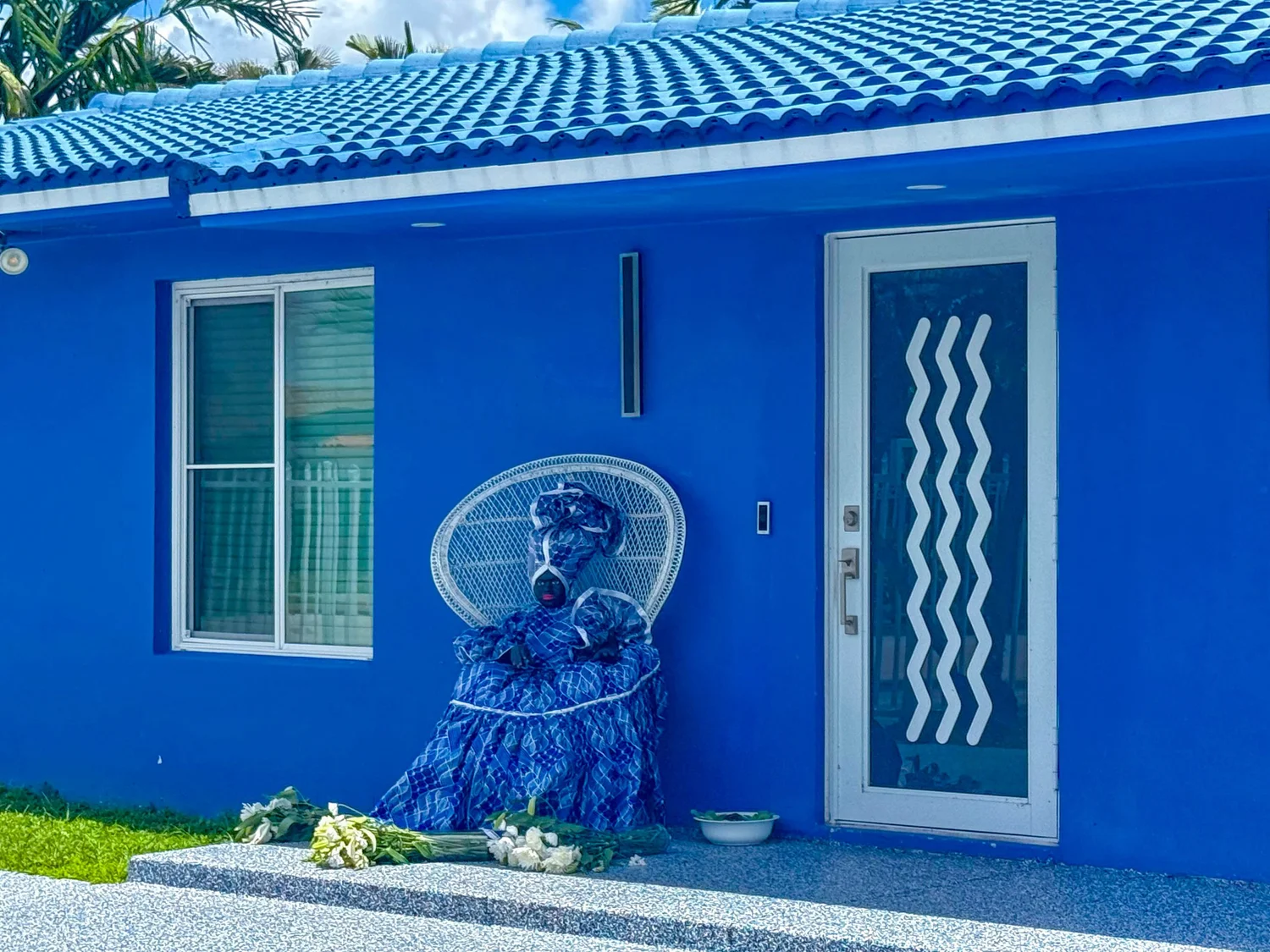
Naming both halves of the process lets me stop treating the car as a failure of the “real” thing and start treating it as a necessary extension of it — the means of covering ground a walker in this city no longer can, in this economy, on these streets, with this transit system, and then, when something demands it, the means of getting out and joining the walkers anyway. The windshield flâneur isn't a lesser flâneur making do. It's a mode of looking built for a city that stopped making room for its own walkers, practiced by someone who decided to keep noticing it regardless — even as the corners worth noticing keep disappearing, even as I'm no longer certain how much longer this particular road will still be open to me.
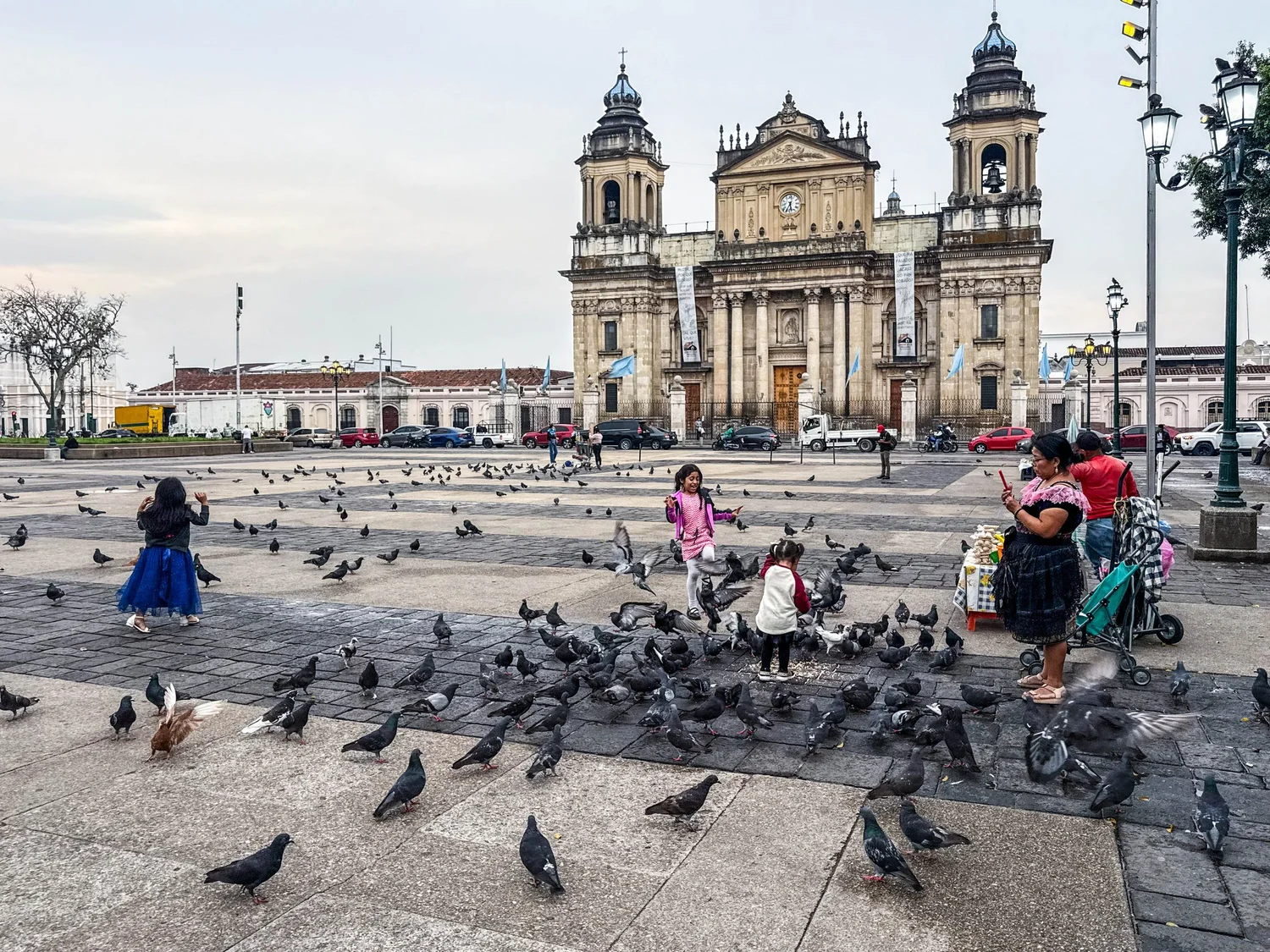
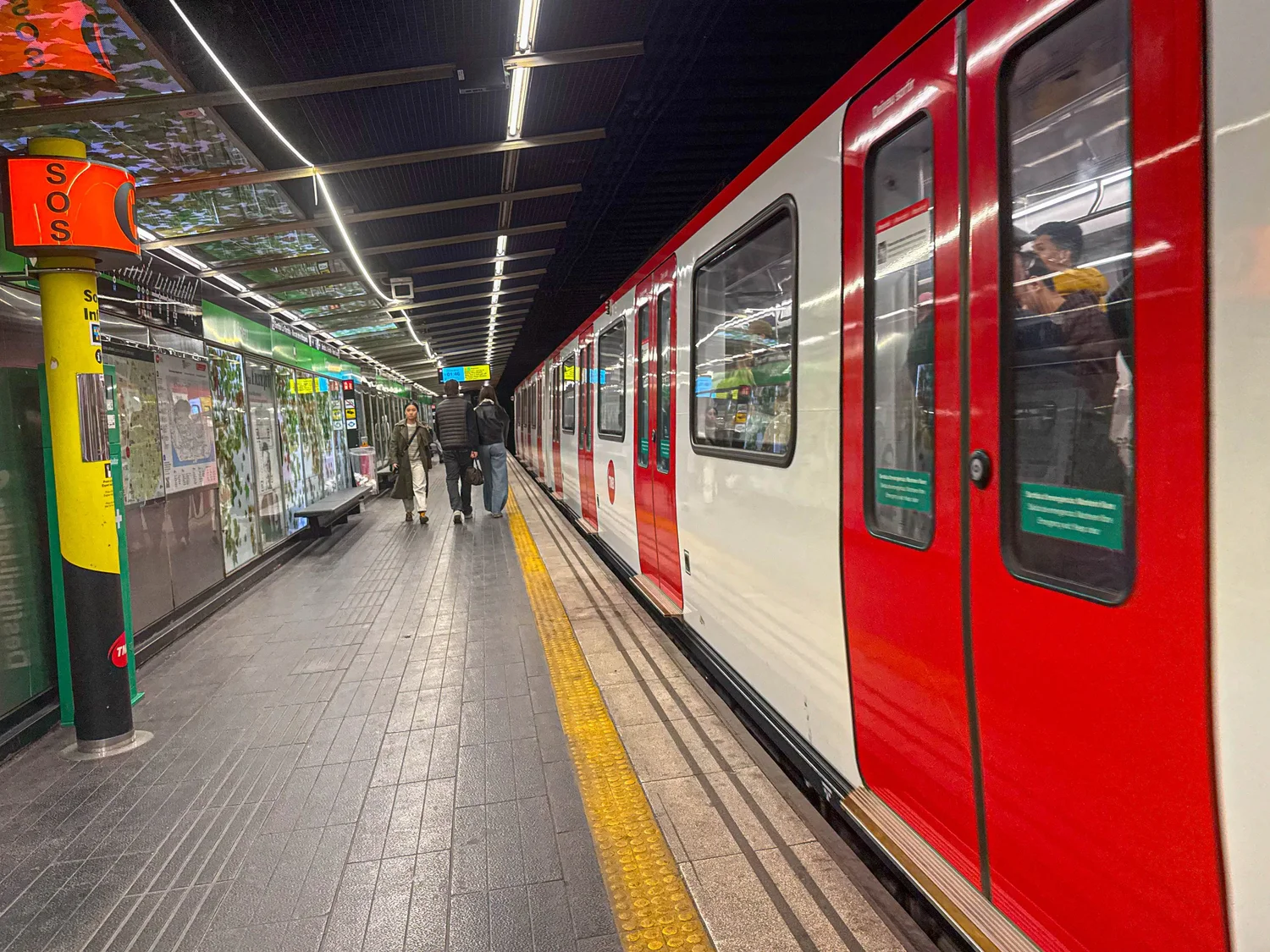
None of this is a permanent identity so much as a response to terrain. It belongs to Miami, to Florida, to a state built around the assumption that everyone has a car. When I'm in New York, or Chicago, or any American city that still takes its pedestrians seriously, I leave the windshield behind and go back to being a flâneur in the older sense — on foot, unhurried, nothing between me and the street. And when I travel outside the country, into cities built centuries before anyone imagined a car, the practice is at its purest: walking without an agenda, reading the street the way Baudelaire's gentleman read it, no glass anywhere in the frame. I felt it standing in the plaza in front of Guatemala City's cathedral, pigeons scattering as a kid chased them, no car in sight for blocks. I felt it on a Barcelona metro platform, the whole frame arranged by the simple fact of having walked down a flight of stairs instead of having parked. Those pictures don't ask anything of a windshield. They never needed one. Change the ground under my feet and the practice changes with it. What doesn't change is the noticing, or the need to keep doing it, whichever form it has to take.
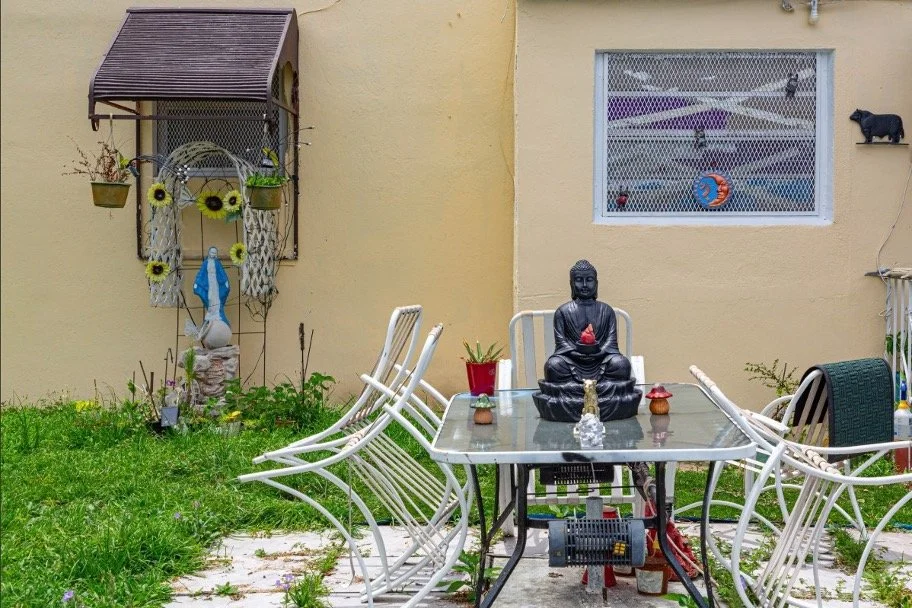
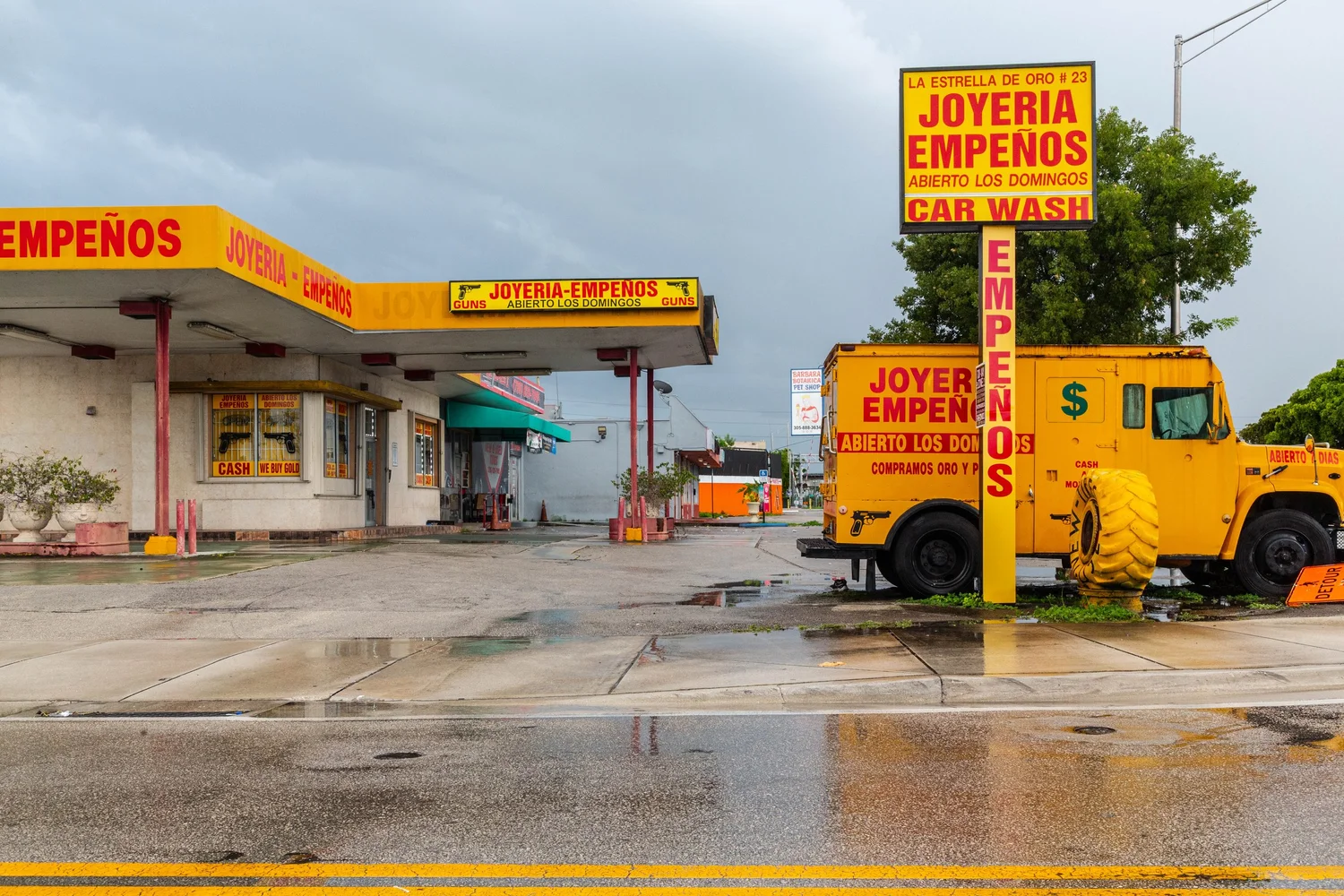
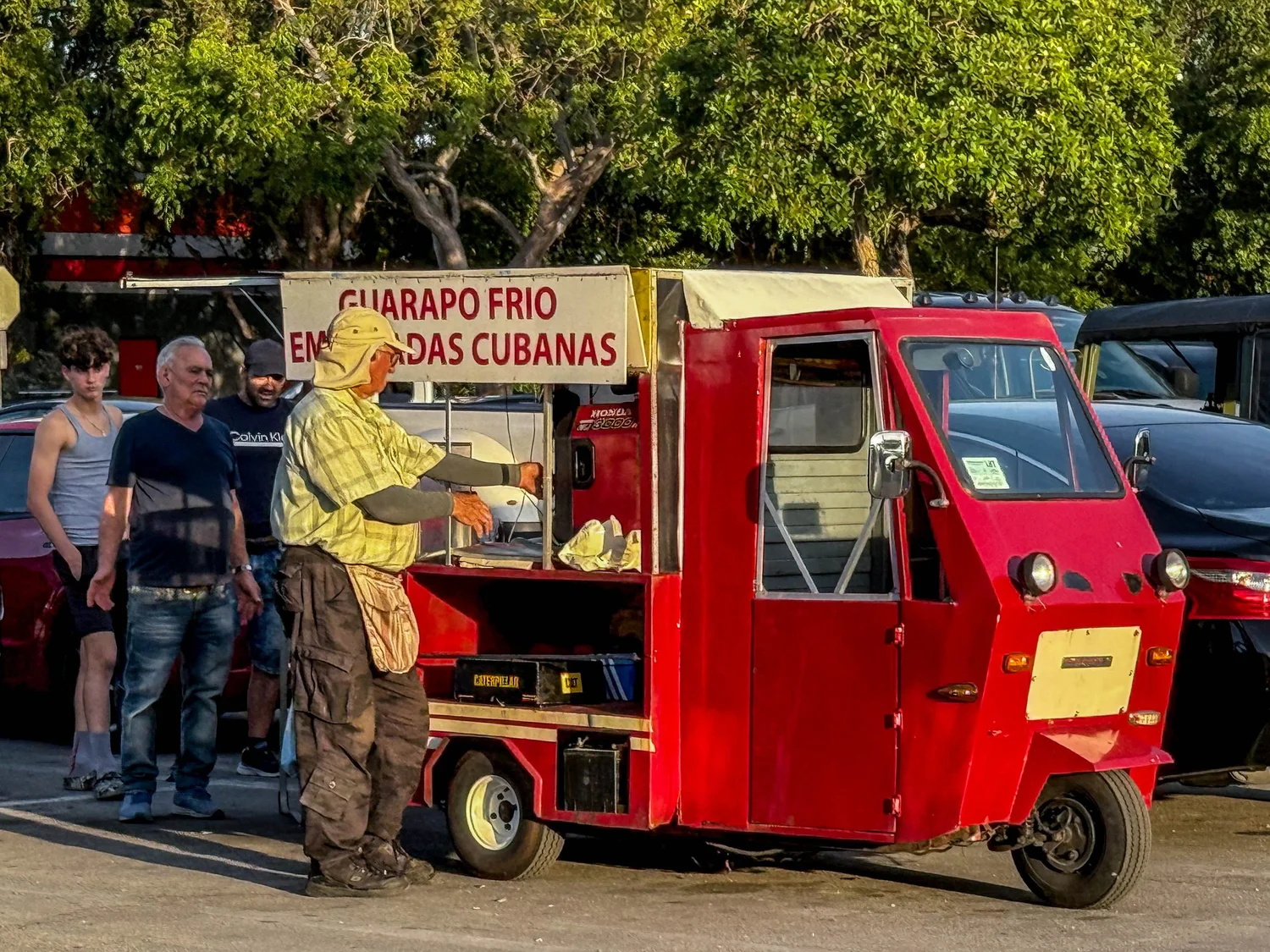
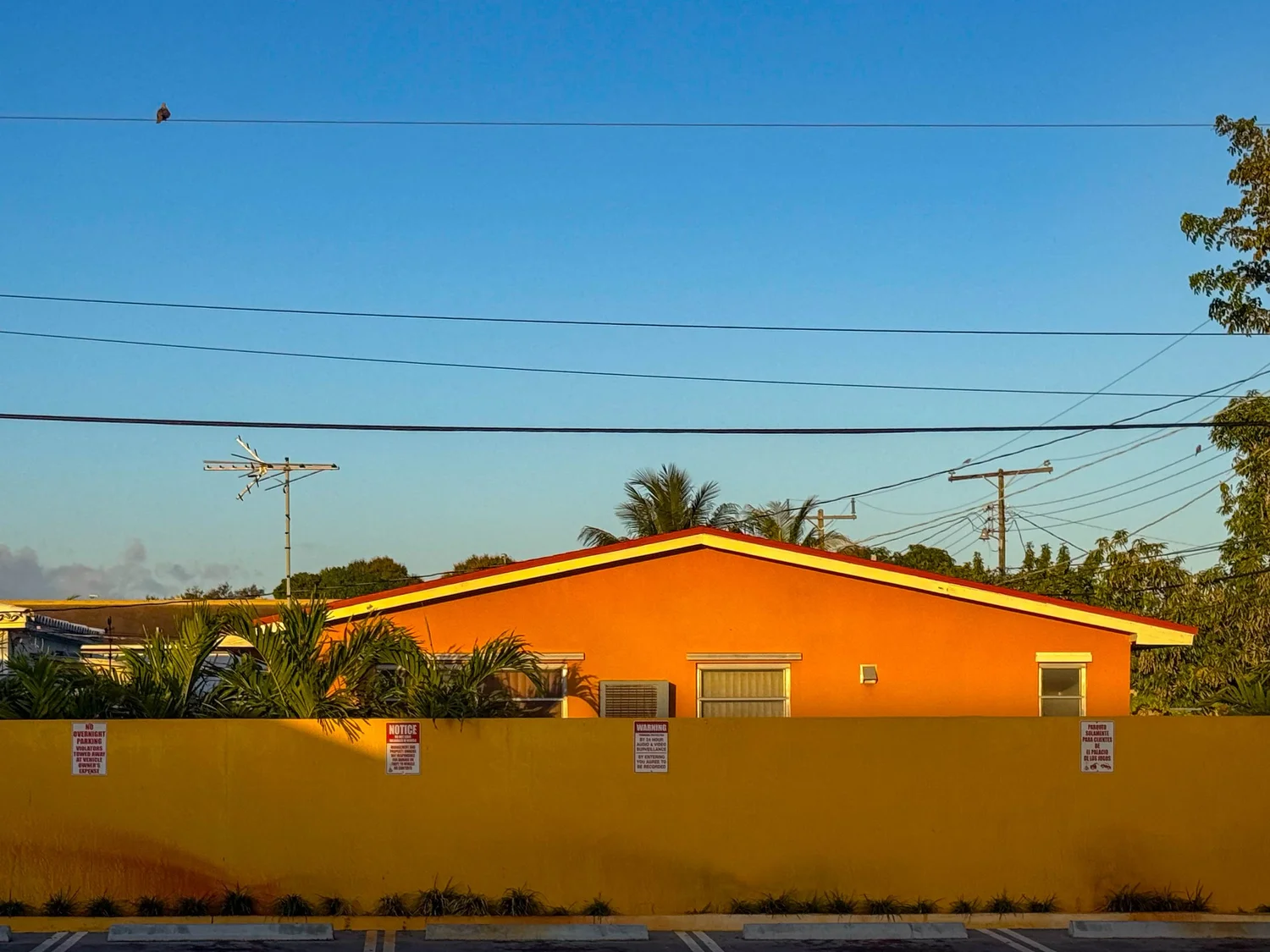
I've been calling the Miami half of this record Miami Unscripted — an ongoing, undramatic archive of the city's quiet, unpolished truth, the small dramas unfolding between one breath and the next. A Buddha statue and a sunflower wreath arranged on a plastic patio table in Allapattah. A pawn shop and a car wash lit up yellow and red against a rain-wet street in Hialeah. A guarapo frío cart parked under a tree in a Kendall lot, its vendor mid-transaction. A single bird on a wire against the flat orange wall of a house at sunrise. None of it is dramatic. All of it is proof I was there, looking, whether I'd parked the car five minutes earlier or fifty. I used to think that kind of documentary depended on finding it on foot. I know now it only depends on stopping. Whether I'm walking when I do, or not.
There's a bigger question sitting underneath all of this, one no camera has answered for me yet. In a few years I retire from the job that actually pays for all of this — the one that has nothing to do with any of these pictures — and the question stops being rhetorical. Whether Miami keeps being home, or whether home turns out to be somewhere I still have to go looking for, the way I once went looking for it on foot, block by block, in neighborhoods that don't quite feel like mine anymore. I don't know yet. Maybe that was never the windshield flâneur's decision to make. He's only ever been good at noticing what's already there — not at choosing what comes next. Judging by the conversations I keep having, I doubt I'm the only one running that math.
References
Banham, Reyner. Los Angeles: The Architecture of Four Ecologies. New York: Harper & Row, 1971.
Baudelaire, Charles. “The Painter of Modern Life.” In The Painter of Modern Life and Other Essays, translated by Jonathan Mayne. London: Phaidon Press, 1964. Originally published 1863.
Benjamin, Walter. The Arcades Project. Translated by Howard Eiland and Kevin McLaughlin. Cambridge, MA: Belknap Press of Harvard University Press, 1999.
Campany, David. The Open Road: Photography and the American Road Trip. New York: Aperture, 2014.
Frank, Robert. The Americans. Paris: Robert Delpire, 1958; New York: Grove Press, 1959.
Fujiwara, Shinya. American Roulette. Tokyo: Chikuma Shobo, 1988.
Ruscha, Ed. Twentysix Gasoline Stations. Los Angeles: self-published, 1963.
Shore, Stephen. Uncommon Places: The Complete Works. Revised edition. New York: Aperture, 2004.
Photographic Series by the Author Referenced in This Essay
Riera, William. America, A Journey as a Metaphor. Ongoing.
Riera, William. Miami Unscripted. Ongoing.
Riera, William. Highway 27: In Search of My Eudaimonia. 2022.
Riera, William. Miami Urban Silence. 2020.
Riera, William. Altares Urbanos. 2015–2020.
William Riera (Santiago de Cuba, Cuba, 1967) is a Cuban American photographer and independent art curator who lives and works in Miami, Florida. He is the founder and Director of the South Florida Latin American Photography Forum (SoFLaFoto).