
Queer Vision in the Archives of the Fuentes Angarita Collection at the Exhibition “30 años de irreverencia y visión”
By William Riera
June 4, 2026
In 2022, SoFLaFoto — the Miami-based South Florida Latin American Photography Forum — began developing what would become Picturing Queerness in the Americas, though it didn't yet have a name. The idea was cumulative from the start, a platform to compile, document, and make visible artists whose work addresses queer representation in the Americas, understood in its broadest geographic and thematic scope. Each year, for Pride Month, the archive grows: a new artist, a new group of artists, another set of practices added to the record. What began as an initiative is now, in its fourth year, a framework — not by declaration, but by accumulation.
Picturing Queerness in the Americas works simultaneously as a virtual collective exhibition and as a provocation. It brings together visual artists living and working in the United States, across Latin America, or anywhere in the world whose practices or projects are grounded in Latin American or Latinx themes — and whose work opens a gateway into the multiple, irreducible forms of self-identity that coexist in contemporary society. The project has never defined queerness narrowly. In the language of its own founding statement, it is a "provocative gesture that explores diverse forms of being and existing within the concept of self-identity" — an invitation to enter, to go deeper, and to become more aware of identities that resist fixed categories.
It is also, and this matters, a celebration and a homage: to the LGBTQ+ community, to its struggles, its hopes, and everything it has been reaching toward. It is research in the service of recognition.
For this June 2026 edition — the fourth installment of this archive — SoFLaFoto turns its attention toward a private collection that has been doing its own version of this work for thirty years. In March 2026, I visited the exhibition "30 años de irreverencia y visión" (Thirty Years of Irreverence and Vision) at the Museo Centro de Artes de Vanguardia La Neomudéjar in Madrid, the first major European presentation of the Fuentes Angarita Collection. What I encountered was not a discovery but a recognition: works that have been doing, quietly and under pressure, what this research turned into an archive is still learning to name.
This art review forms part of SoFLaFoto's contribution — not a conclusion, just another voice in an ongoing conversation. What follows is the record of a visit to the collection, the exhibition, and the artworks of the artists behind them. Some of these names are widely recognized; others are being encountered here perhaps for the first time — and that is precisely why this archive exists.
The Fuentes Angarita Collection is a private archive of contemporary art founded by Venezuelan-born, Miami-based artist and philanthropist Andreina Fuentes Angarita (b. Caracas, 1968). Its origins are inseparable from Venezuela's political upheaval: established first as the Foundation for Emerging Art in Caracas in 1996, the collection migrated to Miami after the political situation in Venezuela put her family's life at risk and was formalized under its current name in 2006 through the Arts Connection Foundation. Today it holds over 1,500 works by more than 150 artists across photography, video, installation, and performance — organized not by geography or chronology but by a set of persistent concerns: identity under coercion, the body as resistance, the experience of diaspora, and the preservation of communities that institutional collections have consistently failed to document.
The collection's emphasis on these media is not incidental — it is structural. Photography, video, and performance documentation are the most portable and reproducible forms available to artists working under political pressure: they survive displacement, require no institutional infrastructure, and can be replicated if originals are lost or destroyed. Performance documentation adds a further dimension: to collect the trace of an ephemeral act rather than a permanent object is, for a collection organized around resistance to fixed categories, itself a political and philosophical position.
As both collector and practicing artist, Fuentes Angarita occupies an unusual position — one that refuses to separate the act of looking from the act of being seen.
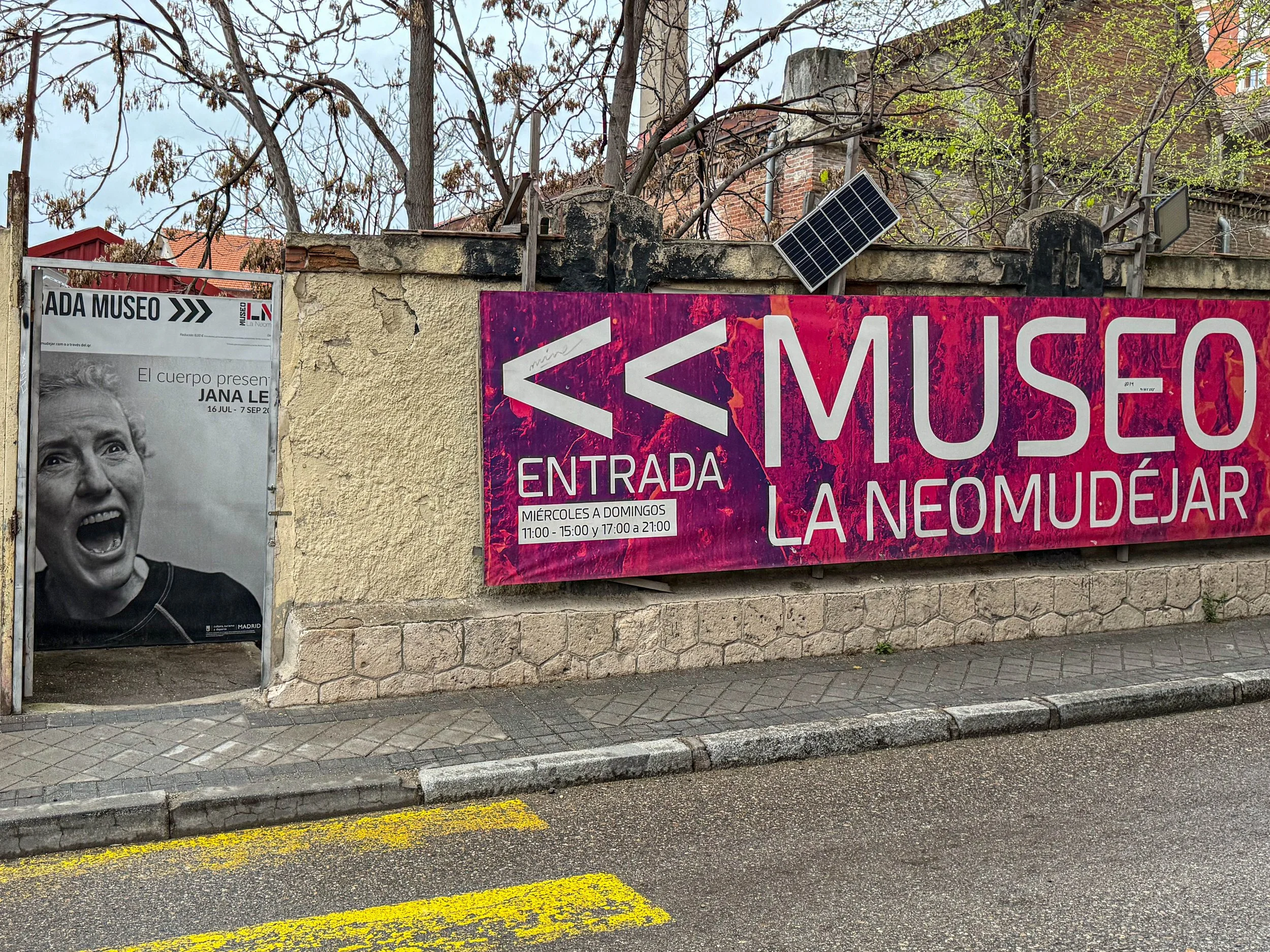
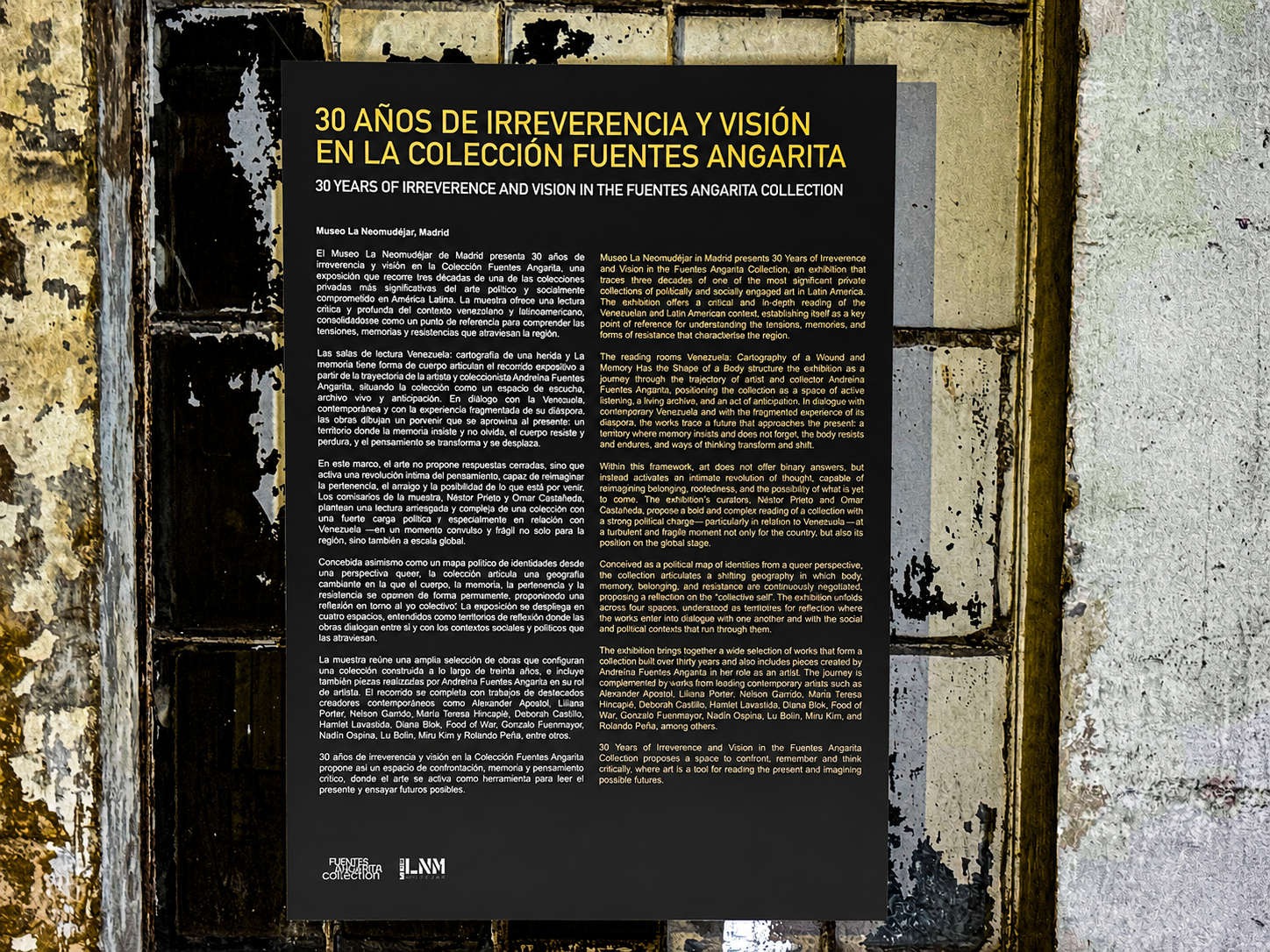
Exhibition title panel — "30 años de irreverencia y visión en la Colección Fuentes Angarita," Museo La Neomudéjar, Madrid, 2026. © William Riera
The exhibition opened on February 25, 2026, at Museo La Neomudéjar in Madrid — one week before the Semana del Arte de Madrid (Art Week in Madrid) — and ran through April 27. It was the collection's first major European institutional presentation after nearly thirty years of activity based in Miami. At the same time, the Arts Connection Foundation announced its patronage of the electronic art prize at ARCOmadrid 2026, placing the collection at the center of Madrid's art week.
Over 130 works by 68 artists filled four spaces across the museum — painting, sculpture, photography, video, and performance documentation side by side. The care devoted to conserving video art and performance records was unmistakable: this felt less like a conventional exhibition and more like an archive that had finally decided to make itself visible.
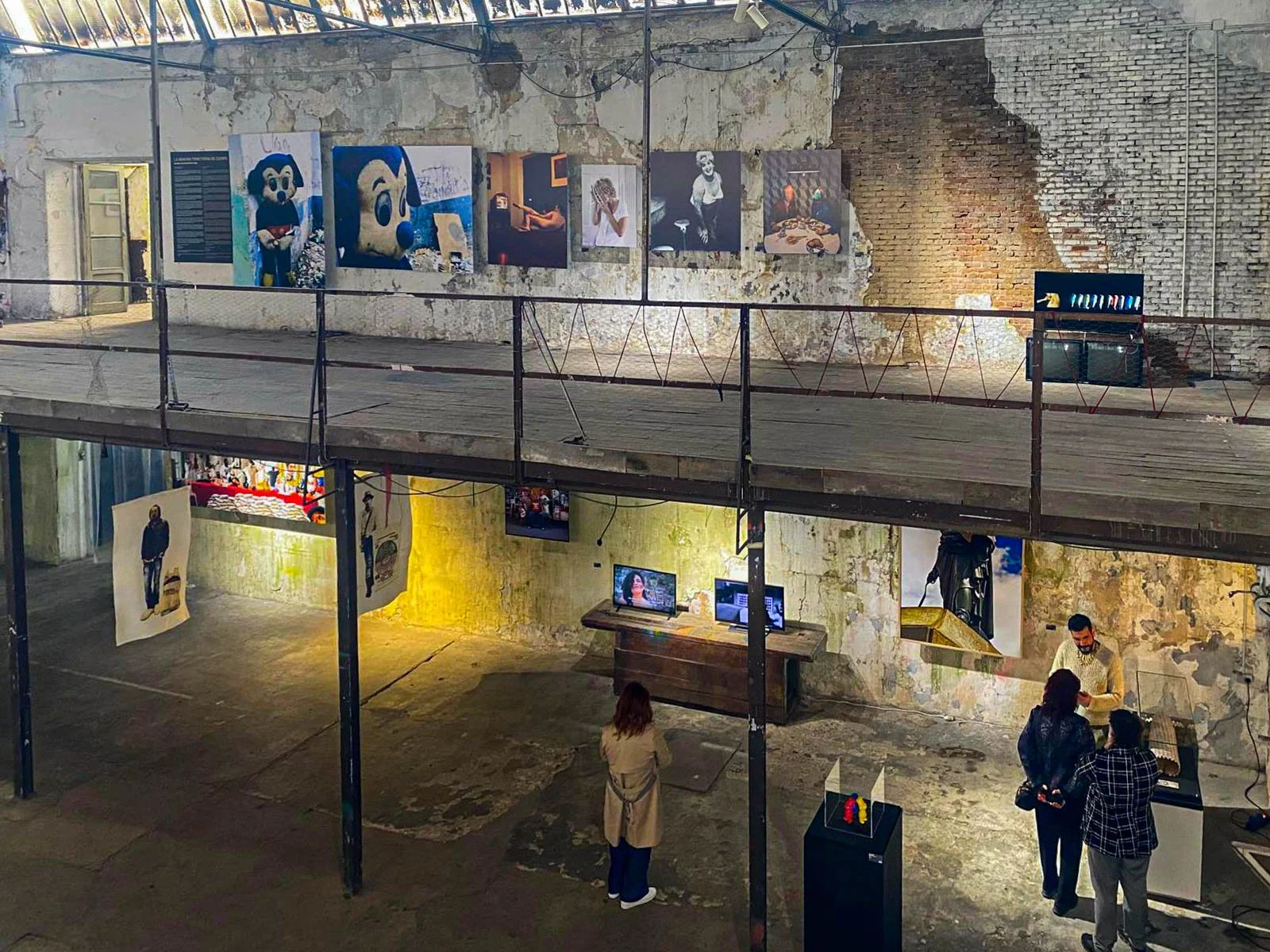
View of the main hall of the museum. © Raquel Cartaya
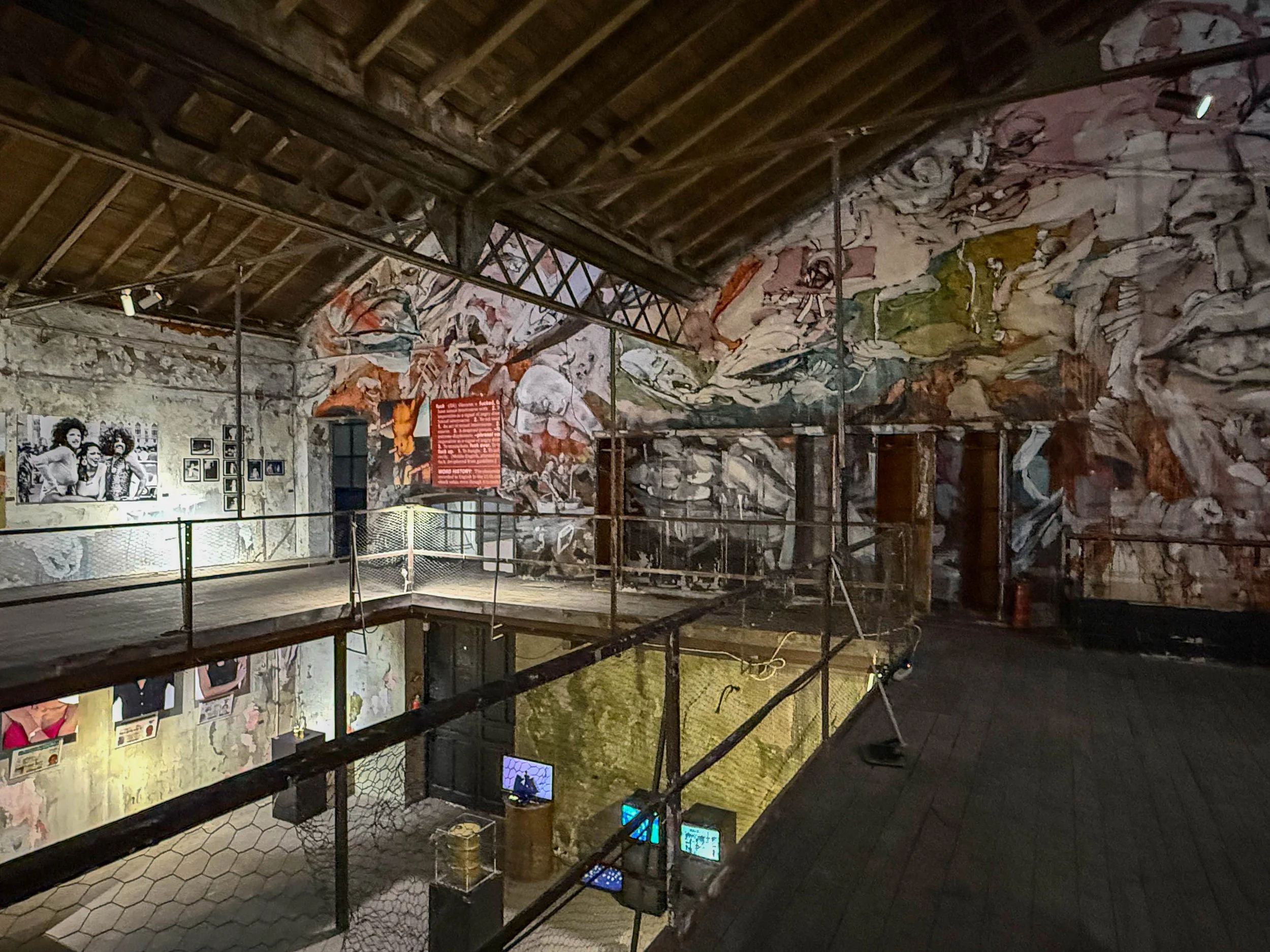
The queer dimension of the exhibition occupied the second floor of the main nave — a structural addition visibly grafted onto the original 1885 walls, its industrial metal scaffolding and mesh railing making no pretense of permanence. Walking through it, the floor moves slightly underfoot. Far from feeling like a lesser space, this instability carries its own meaning: queer lives, queer histories, and queer bodies have rarely been granted the illusion of solid ground, and here the architecture refuses to offer one. Not all of the artists whose work appears in this section identify as queer. What connects them is not a shared identity but a shared field of inquiry — each has produced work that takes queer lives, bodies, histories, or representations as its subject, its form, or its point of departure. What follows is a record of those works and the artists behind them — Nelson Garrido, Manuel Herrero de Lemos, Mateo Manaure Arilla, Gabriela Morawetz, Gustavo Marcano, César Rojas, Ultra Violet, Muu Blanco, Fran Beaufrand, Alexander Apóstol, Consuelo Castañeda, Carlotta Boettcher, Diana Blok, Rolando Peña, Dan Perjovschi, and Andreina Fuentes Angarita — whose practices, rooted primarily in Venezuela and extending across various parts of the world, map the Americas as a body that refuses to forget.
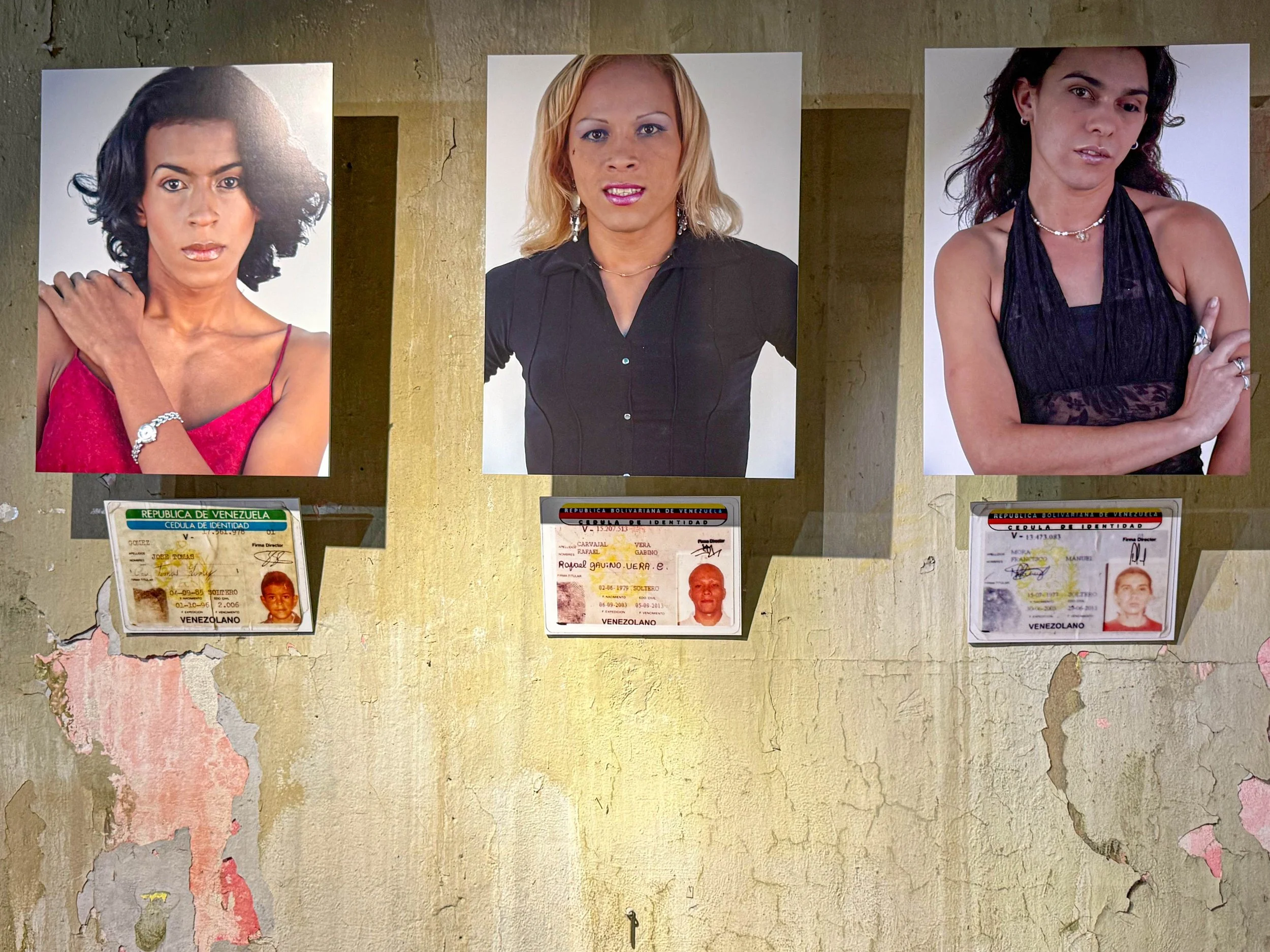
The entry point into this queer constellation is, perhaps surprisingly, not on the second floor at all. Nelson Garrido's Trans-Mission Identidad (2005) — three photographs, 100 × 70 cm each — hangs on the main floor alongside the overtly political work, and that placement is itself a statement: trans identity is not a subcategory of the political; it is political. The compound title says it plainly: "Trans" as prefix destabilizes "Mission Identidad," the Venezuelan government's own identity documentation program under Chávez, folding trans existence directly into the language of state control. It is the first work you encounter that belongs to this constellation, and it asks to be read on those terms before you have even begun to climb.
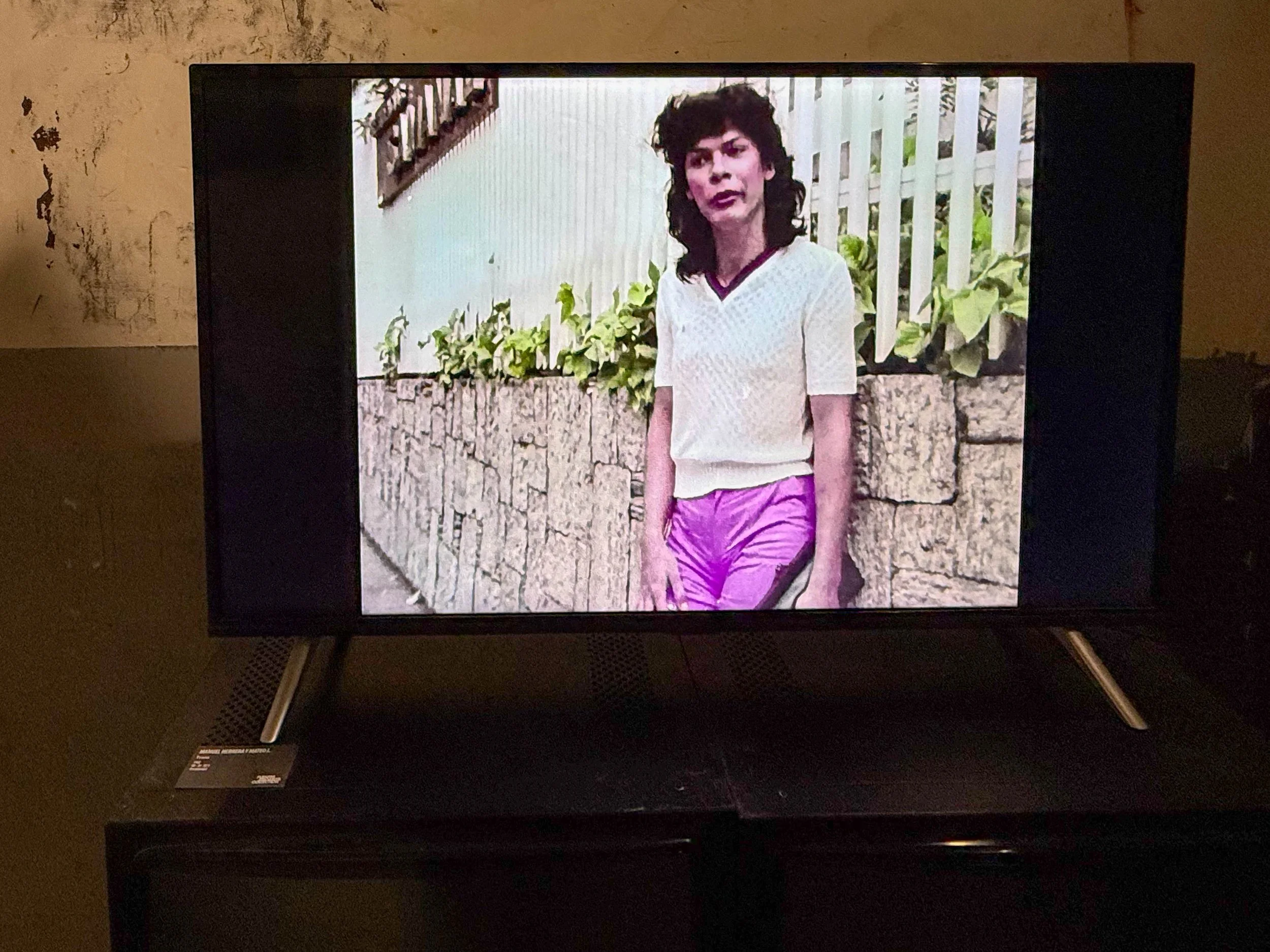
The second floor opens into a closed room — contained, interior — whose character is unlike anything in the warehouse around it. The walls carry floral wallpaper, the floor is tiled, old cabinetry lines the far end — not installed as a curatorial gesture but preserved as found, part of the building's own layered history of domestic and institutional use. Into this already inhabited space, Manuel Herrero de Lemos and Mateo Manaure Arilla's Trans (1982) plays on a screen: twenty-two minutes of documentary film following a group of trans women in the Bello Monte neighborhood of Caracas, recording their dreams and resilience in a city that was simultaneously surveilling and erasing them. The film stopped me.
In a room that already spoke of other lives lived and forgotten within its walls, the footage of those women — shot the same year police attempted to arrest the filmmakers and their subjects at the film's premiere — demanded the kind of attention that only stillness can give. Around me as I watched, Gabriela Morawetz's nine pigment-on-canvas works from 2009 lined the walls, their titles drawn from French legal terminology governing conjugal relations — Influences de conjoint, Le conjoint des ennemis, Circonstances ou causes — mapping the law's regulation of intimate life against wallpaper that once covered a domestic interior. Her two Sleeping Self studies (2008), photographs constructed as physical palimpsests with layered screens and reflective surfaces, proposed the unconscious as the only territory where identity fully escapes classification. The layered screens and reflective surfaces are not technique — they are the formal argument: a surface that shows you yourself while rendering you partially opaque, holding the viewer in the same suspended condition the title names. The room held all of this simultaneously: film, canvas, photograph, wallpaper, old wood, tile — each surface carrying its own memory, each work adding another layer to what the space was already saying.
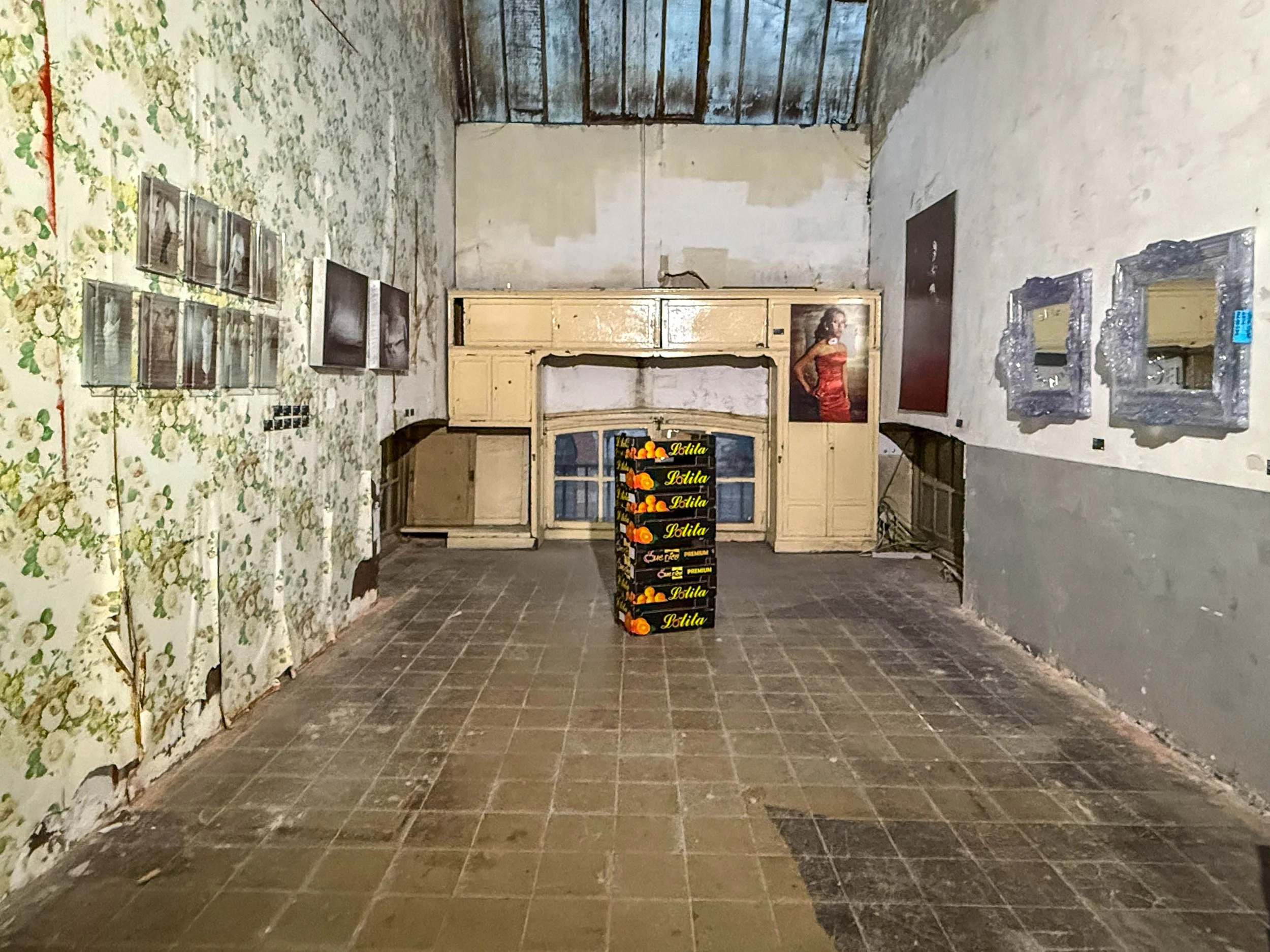
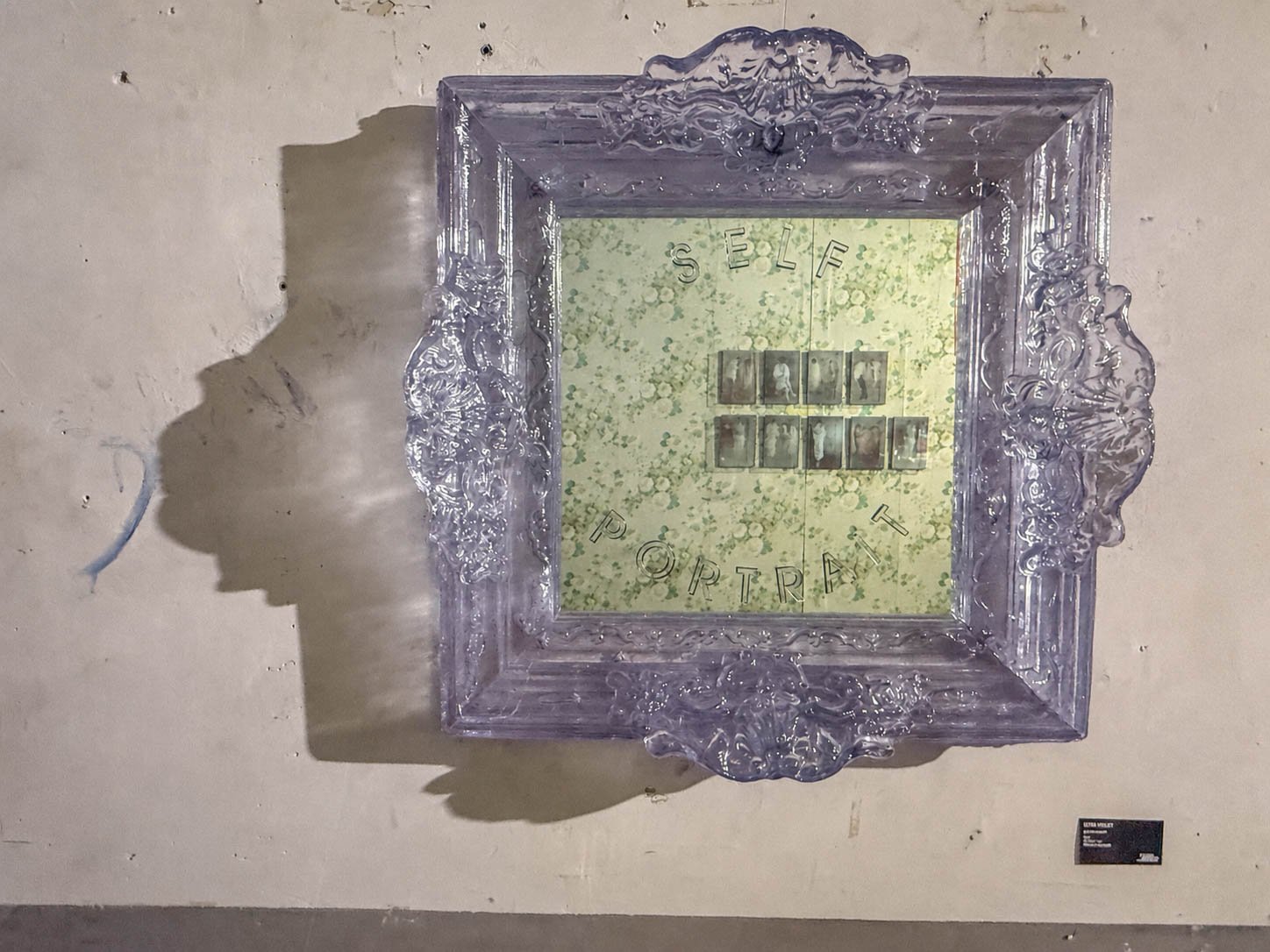
Gustavo Marcano's La Noche de las Luciérnagas (2004) and César Rojas's Untitled (Trans person at night) (c. 2008, 138 × 90 cm) complete the room in productive tension with each other. Marcano's enlarged photograph documents a gathering of young men in Carúpano, Venezuela, who used the social permission of carnival to express their sexual orientation publicly for the first time — a community in motion, briefly and collectively visible. The subtitle of the full series, Una tradición fuera de registro — an unregistered tradition — names exactly what the collection as a whole is doing: preserving what official records omit. Rojas's photograph works differently: still, nocturnal, protective of its subject's anonymity. The parenthetical title names what it can — trans, night — and leaves the rest alone. Between Marcano's collective emergence and Rojas's solitary darkness, Ultra Violet's Self Portrait and Selfie (both 2014, resin, acrylic, and mirror) hold the room's right wall. Isabelle Collin Dufresne, born in France in 1935, was a superstar in Andy Warhol's Factory before renouncing that world entirely for the Church of Jesus Christ of Latter-Day Saints in 1981. These works, made in the last year of her life, place the viewer inside the image rather than outside it — resin and acrylic surfaces that give back the face looking in. The self-portrait and the selfie, one art-historical and one vernacular, held in the same material, asking the same question: who gets to occupy the image, and on whose terms.
Emerging from that room into the open expanse of the second floor, things open up — in scale, in register, in what the works are willing to say out loud.
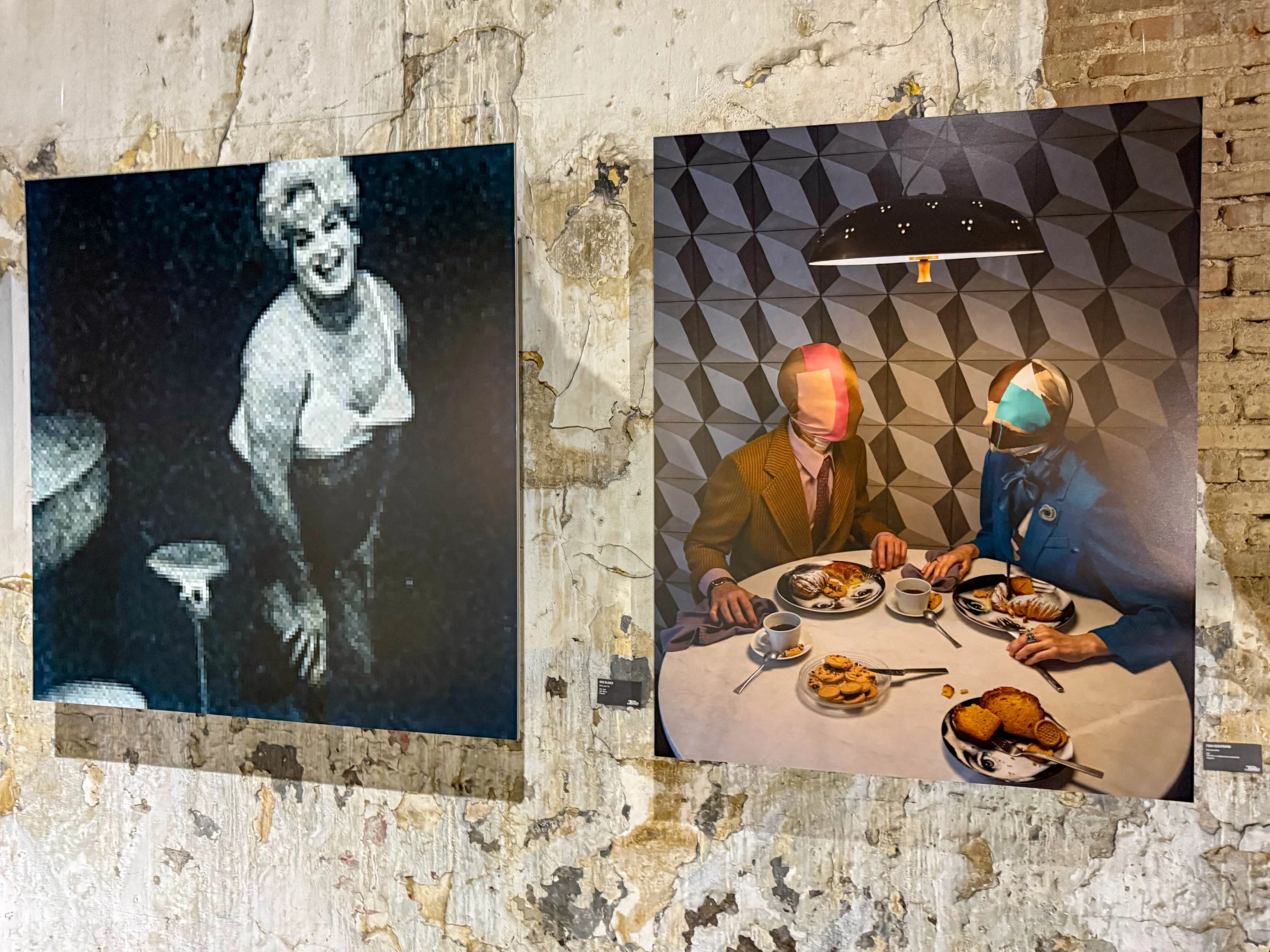
Muu Blanco's Ella soy Yo (Re Sampling) (1992/2018) — "She is me" — belongs to his reconversión series: a work of appropriation in which an existing image is resampled and reclaimed, the declaration of the title transferring authorship and identification onto the borrowed subject. Its dual date marks its origin in the same early-1990s Caracas moment as Beaufrand and Garrido, and its return twenty-six years later in Miami. Fran Beaufrand's two final works, Formasetti and Criminal Love (both 2021), hang nearby — photographs made two years before his death in September 2023, working in a register of excess, artifice, and transgressive desire that his practice never abandoned from its earliest drag self-portrait. His posthumous presence here, alongside Ultra Violet's posthumous Self Portrait in the room behind, gives this part of the floor a quiet elegiac weight — an archive of the recently lost, holding its ground. Manuel Herrero de Lemos's Serie Trans (1982, Edition 2/5) reappears on the open floor as its own body of work — thirteen photographs that stand independently from the documentary film playing in the room below, yet inseparable from it in subject and moral urgency. Where the film moves, these images hold still: the same women, the same Caracas, the same year, fixed into a photographic series that the archive has kept in two distinct forms because one was not enough.
Not every work on the open floor engages the queer narrative as directly as the room below. The curatorial logic here appears to expand rather than specify: works whose relationship to queerness is structural or methodological — the examination of the body, the refusal of fixed identity, the politics of visibility — sit alongside works that are more explicitly queer in subject. Whether this breadth is the exhibition's argument or its accommodation is a question the spatial arrangement leaves open.
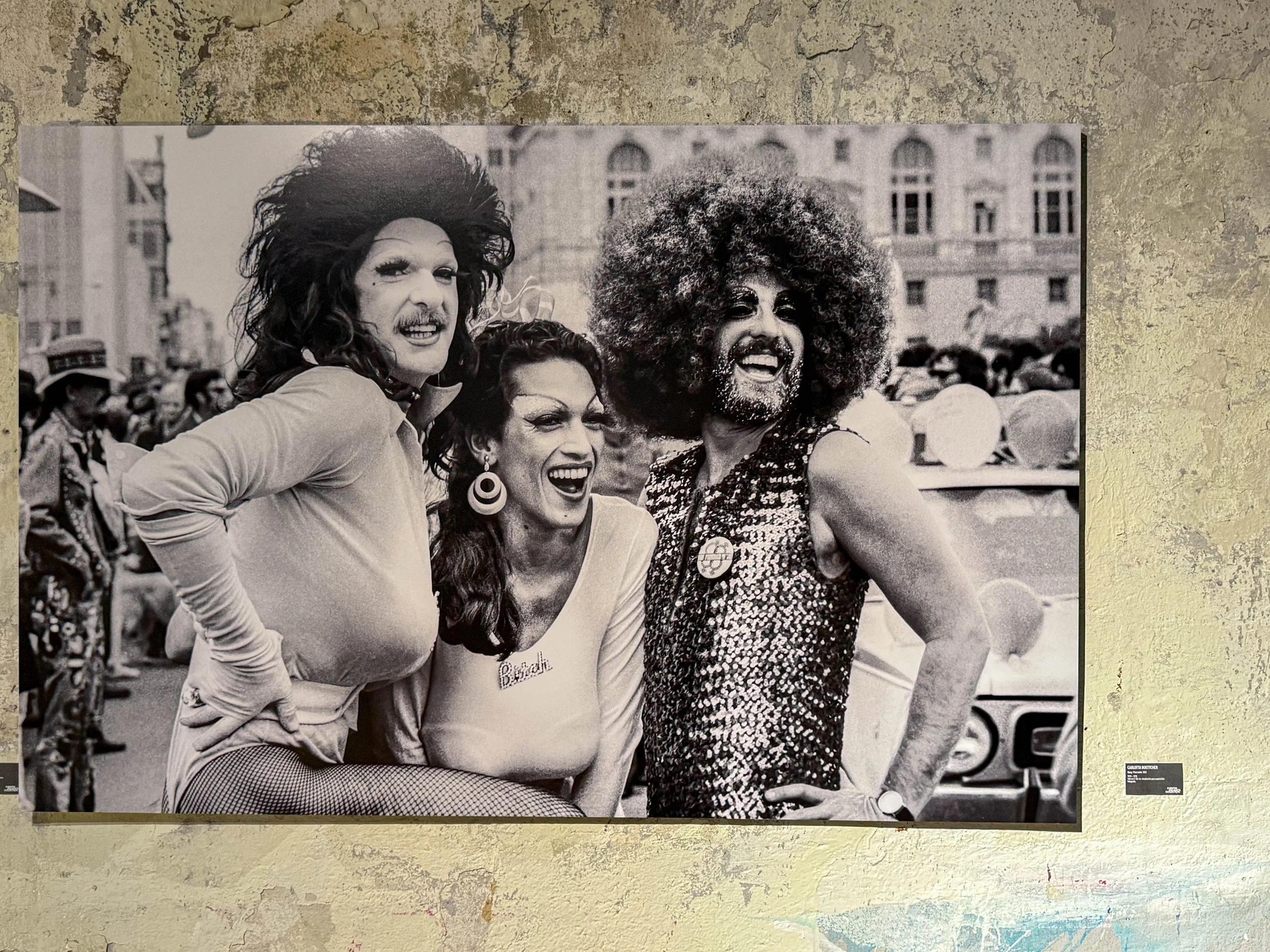
Carlotta Boettcher's Gay Parade III (1972–1978), the earliest dated work in the entire constellation at 143 × 156 cm, pulls the eye back to the United States of the early 1970s — more specifically to the charged San Francisco scene of that moment — shot by a Cuban-born artist who had come through Paris in May 1968 before landing in a country that was only beginning to imagine what bodies were allowed to demand.
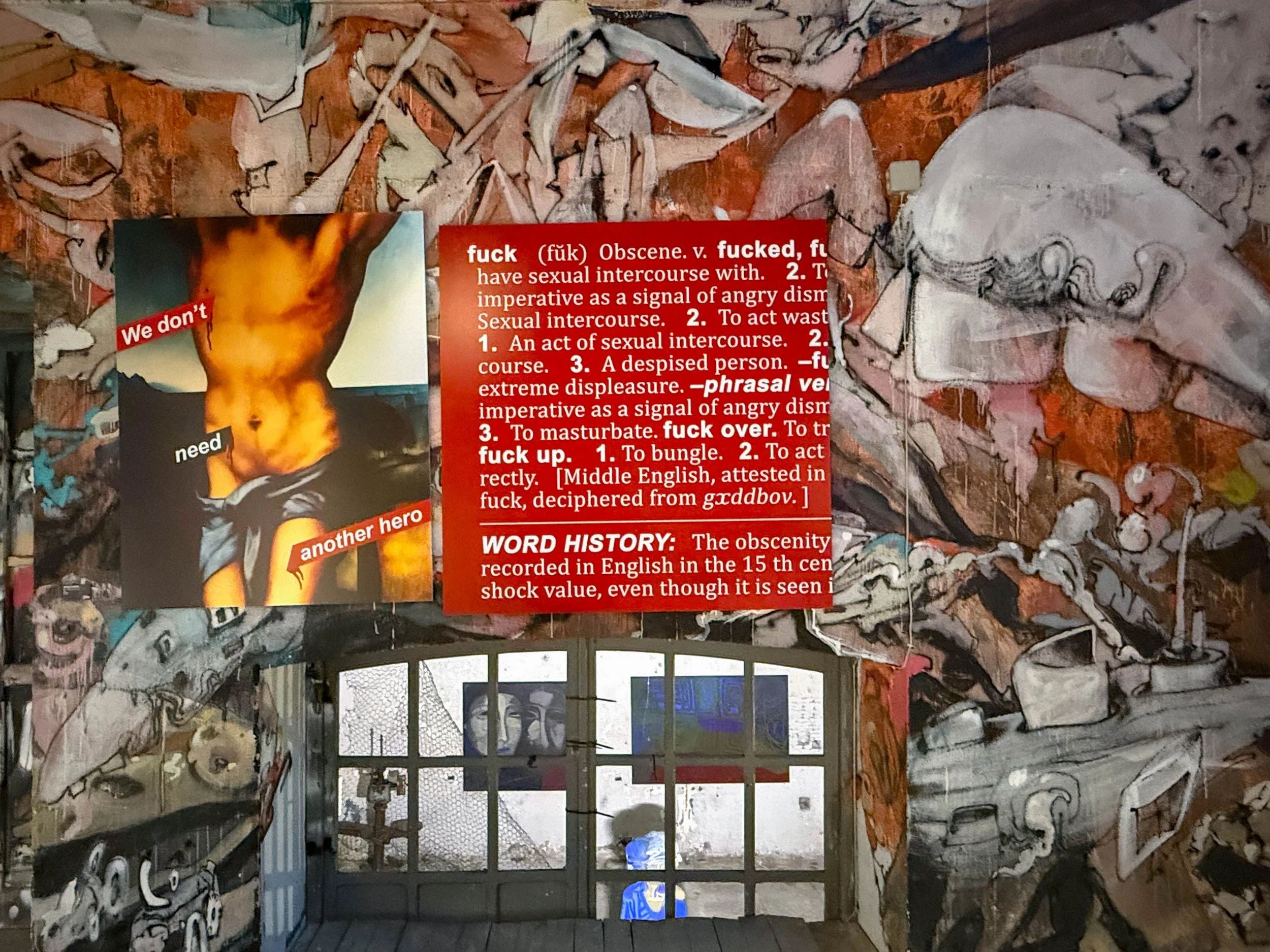
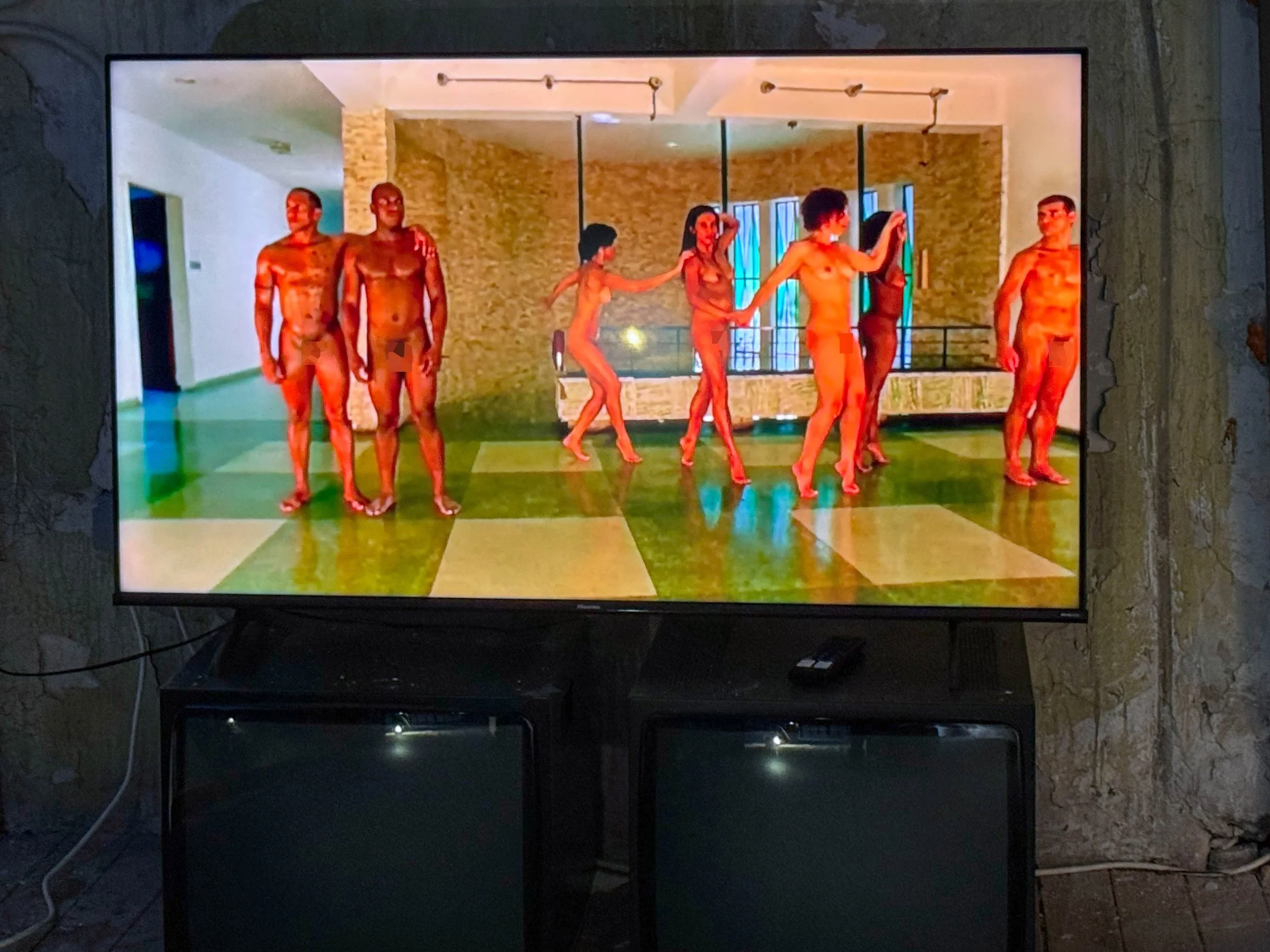
Midway through the corridor, two works face each other across the floor in what feels less like a coincidence and more like a curated argument. On one wall, Alexander Apóstol's Ensayando la postura nacional (Rehearsing the National Posture, 2010–2022, video, 28:38 min) — eight nude figures of different races arranged in a modernist interior, some standing apart, others touching, all trying to hold postures that no single body can sustain. The work takes as its starting point the paintings of Pedro Centeno Vallenilla, a homosexual Venezuelan painter trained in Fascist Italy who produced monumental, homoerotically charged images as official symbols of the nation under the 1952–1958 dictatorship. Apóstol's recomposition using working-class bodies quietly exposes what was always at the center of that nationalist project: a posture that could never be held because it was never meant for real bodies, only for the fiction of a unified, legible nation. Facing it across the corridor, Consuelo Castañeda's To Be Bilingual, Lesson No. 2 (2008) delivers its own lesson in what language is permitted and what gets declared obscene. Two panels against the building's dense, grotesque wall murals: on one side, a photograph of a torso with the text "We don't need another hero" running across it in red diagonal type; on the other, a large red panel displaying the full dictionary definition of the word "fuck" — clinical, complete, nothing redacted — including its word history. The title calls it a lesson. And it is: in power, in classification, in who decides which words belong in a museum and which bodies belong in a nation. Apóstol's unreachable postures and Castañeda's forbidden vocabulary face each other like two versions of the same impossible demand.
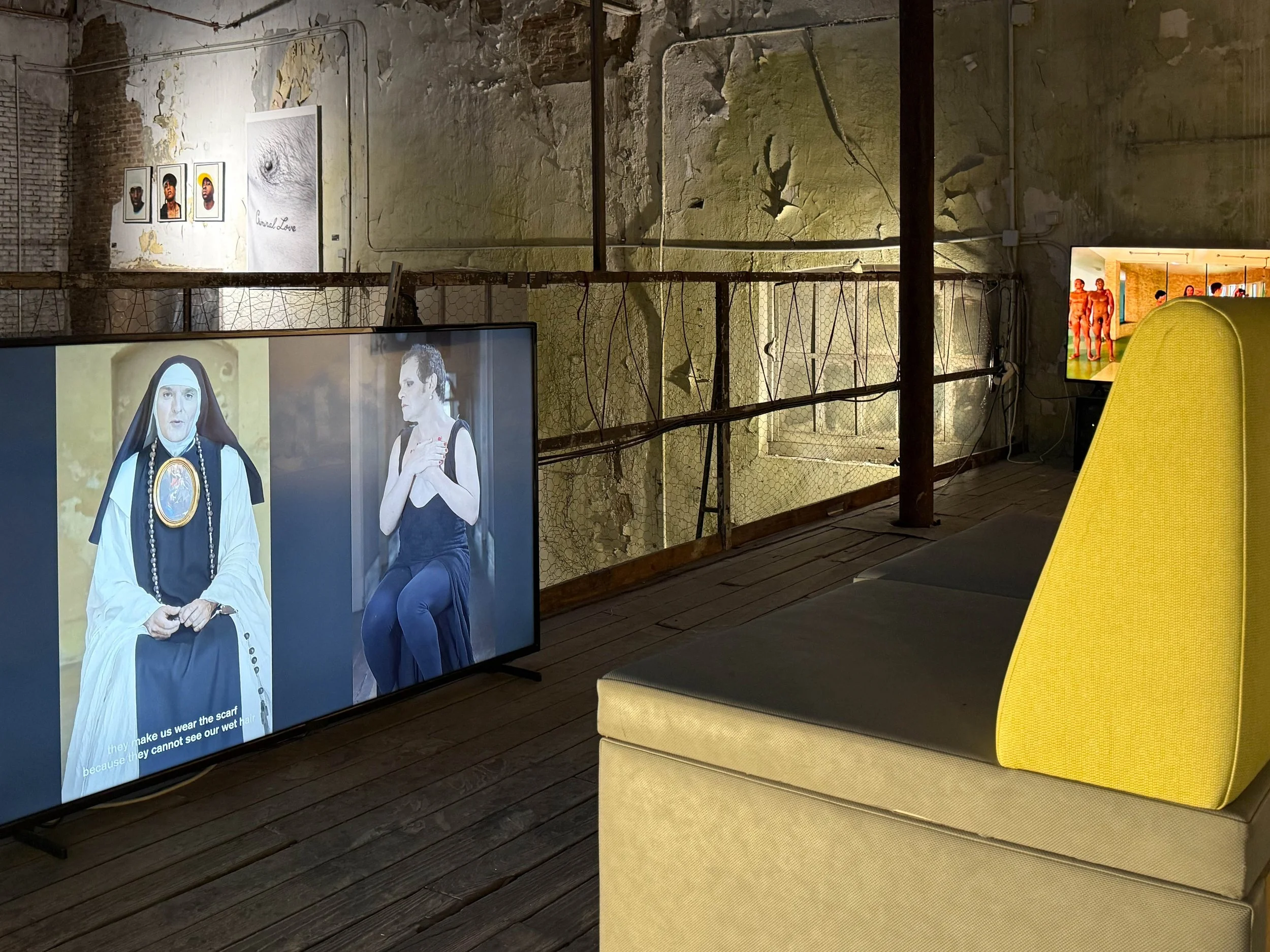
Diana Blok's Act 1: Sor Juana Inés de la Cruz (2023) plays on a flat monitor positioned across from a yellow upholstered seat — a deliberate invitation to stop again, as the film in the room below had asked me to stop, but this time with the full length of the corridor visible behind you, the railing, the raw walls, everything you have already walked through. The screen holds two figures simultaneously: on the left, Jordi Ballester in the habit of a seventeenth-century Mexican nun, on the right a figure in restrained movement, and between them a subtitle reading "they make us wear the scarf / because they cannot see our wet hair" — a line that reaches across centuries and continents, connecting Sor Juana's persecution by the Inquisition to contemporary regimes of bodily control over women and queer bodies alike. A man performing a woman who was punished for knowing too much: the casting is the argument. Rolando Peña's Miss Venezuela 1969 — a digital print from the same year his film screened at Cannes, and the year Venezuela's beauty pageant was being institutionalized as national spectacle — closes one loop in the genealogy: Peña, like Ultra Violet, came through Warhol's Factory and carried that experience into a practice that never stopped asking what national identity performs and for whom.
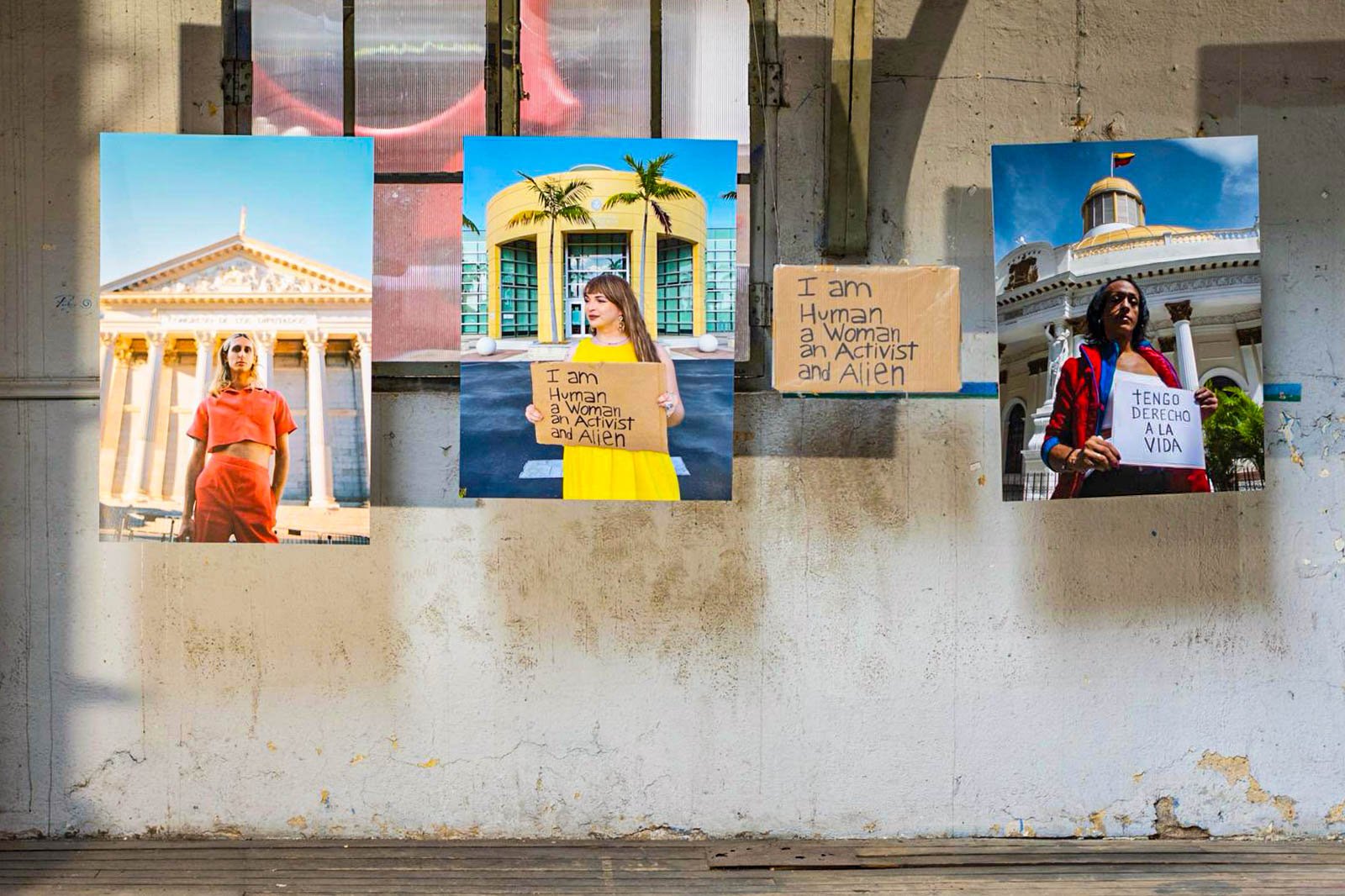
Andreina Fuentes Angarita's triptych Transdecision, Transdecision II, and Transdecision III (2021) brings the collector into her own archive — but not as a self-referential gesture. The work is a documentary project built on accompaniment: Fuentes Angarita was present with three trans women — Gabriela Amaya Cruz in Miami, Rummie Quintero Verdu in Caracas, Alex de la Croix in Madrid — through the legal and psychosocial processes of gender recognition, documenting the dimensions of a civil right that trans communities have been systematically denied. The photographs are not portraits of subjects; they are evidence of a relationship sustained over time, and across the same geography the collection itself inhabits. That the three cities — Miami, Caracas, Madrid — are also the collection's own coordinates is not incidental. The wound the collection has been mapping for thirty years is met here not by the gaze of a collector surveying her archive, but by the presence of someone who chose to accompany rather than observe.
Thirty years of irreverence and vision, gathered in a building that refused to forget its own history, constitute something more than a collection survey. It is an argument about what survives when institutions fail, what bodies carry when states erase, and what images can hold when language gets shut down. The works here — from Boettcher's early 1970s streets to Fuentes Angarita's 2021 triptych — trace a queer genealogy of the Americas that is still being written, still growing, still refusing to settle. For SoFLaFoto's 2026 edition of Picturing Queerness in the Americas, this encounter with the Fuentes Angarita Collection is not a conclusion but a coordinate point — a marker in an ongoing research that, like the collection itself, understands the archive not as a fixed record but as a living act of recognition, expanded each year by the names and works it learns, finally, to name.
William Riera (Santiago de Cuba, Cuba, 1967) is a Cuban American photographer and independent art curator who lives and works in Miami, Florida. He is the founder and Director of the South Florida Latin American Photography Forum (SoFLaFoto).