
SoFLaFoto Publications · Bicentenaire de la photographie, 1826–2026
Flâneur, Flâneuse
Paris, photography and the art of walking. A prelude.
William Riera, with photographs by Yolanda Andrade · October 2026 · Essay with the Paris Photobook Archive
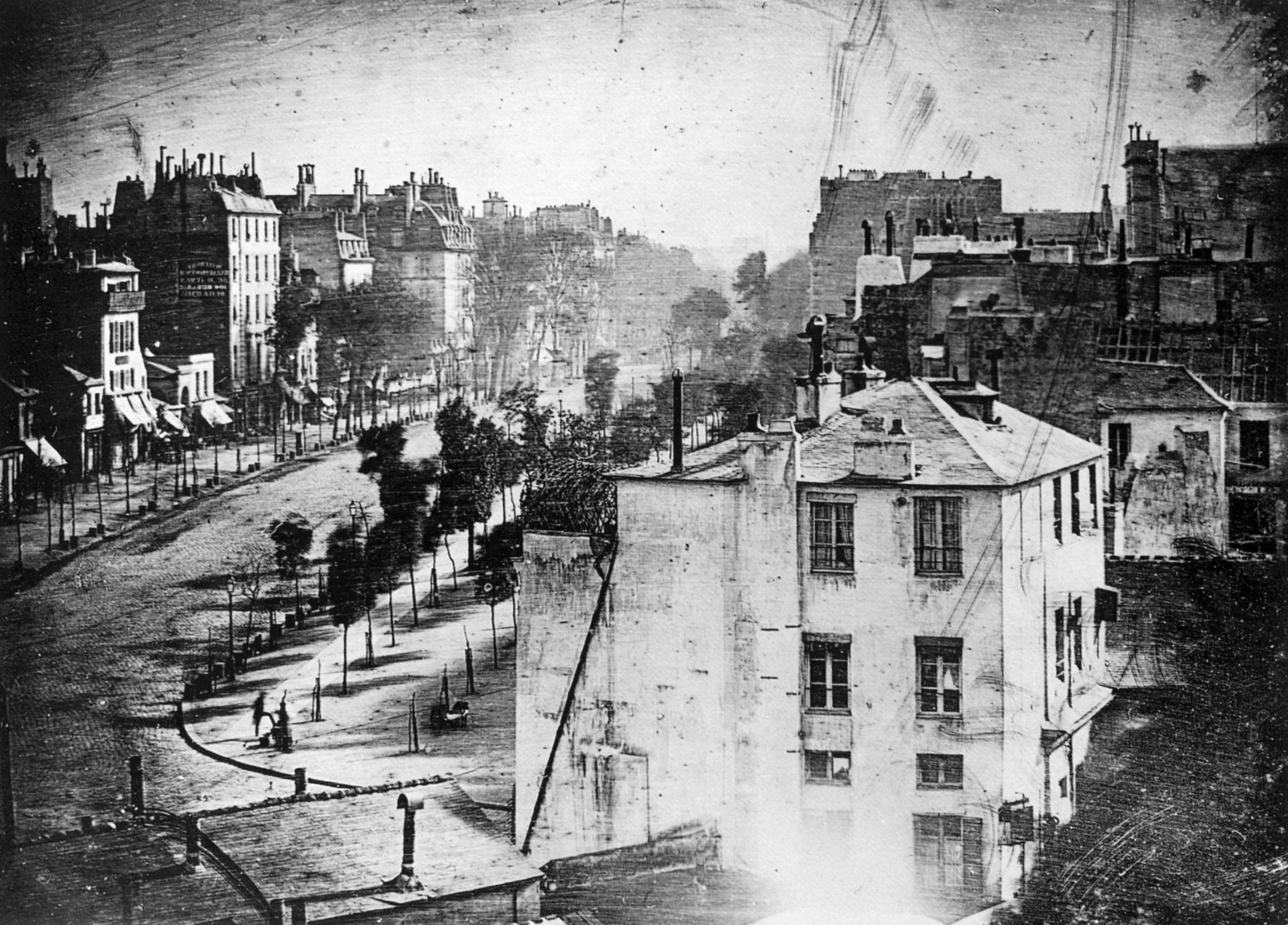
Louis Daguerre, Boulevard du Temple, Paris, 1838. Daguerreotype. The exposure lasted several minutes, so the traffic left no trace; only two men at lower left, one having his boots polished, stood still long enough to remain. Public domain · Bayerisches Nationalmuseum, Munich
Prologue · Boulevard du Temple
The men who stood still
In 1838 Louis Daguerre set up his camera at a window above the Boulevard du Temple, one of the busiest streets in Paris. Below him the boulevard was full of carriages, horses and people on foot. None of them appear in the picture. The exposure took several minutes, and everything that moved crossed the plate without leaving a mark. Only two figures stayed long enough to be recorded: a man on the corner having his boots polished, and the bootblack bent at his feet. They are very likely the first people ever photographed, and they are there because they were still. One had stopped walking. The other was kept in place by his work.
Paris taught the modern world to walk and look at the same time, yet one of its earliest photographs shows a street that is almost empty. The camera kept the two who paused and let the crowd go. Every photographer who has worked in Paris since then has lived with that same trade between the city that moves and the moment that holds still. It is fitting, too, that both figures are men: in 1838 the boulevard belonged to men, and so, for a long time, did the right to wander it.
This year France is celebrating two hundred years of photography. The date goes back to Nicéphore Niépce and the view he fixed from a window of his house at Le Gras, in Burgundy, around 1826 or 1827. The invention did not happen in Paris. But it was in Paris, on 19 August 1839, that François Arago presented Daguerre’s process to the Académie des sciences and the Académie des beaux-arts, and the French state gave it to the world. From then on the city and the medium grew up together. Paris became one of photography’s first great subjects, and the place where photographers from everywhere came to learn what a street can hold.
This essay is a prelude to a walk. In November I will be in Paris again for the fair, and so will Yolanda Andrade, the Mexican street photographer who taught me in several of her workshops and has been my friend for many years. We have walked Mexico City, Miami, Los Angeles and Paris together. In 2024 her photographs hung at Paris Photo, and between the fair and the streets we walked the city side by side. This year our days in Paris overlap only briefly. Before we meet again, I want to set down what we carry with us: the Paris of the photographers in the books on my shelves, catalogued as the Paris Photobook Archive, and the Paris the two of us have already walked.
I · Rue Hautefeuille
Before the camera, the walker
Before photographers walked Paris, writers did. In the middle of the nineteenth century Charles Baudelaire gave the walker a name and a purpose. The flâneur moves through the crowd without hurry, belongs everywhere and nowhere, and turns what he sees into art. In The Painter of Modern Life, published in 1863, Baudelaire wrote that the crowd is the flâneur’s element, as the air is the bird’s.
The strange part is that Baudelaire disliked photography. Reviewing the Salon of 1859, he called it the refuge of failed painters and said it should stay a humble servant of the arts and sciences. The poet who invented the modern walker turned away from the machine that would carry his walk forward.
He was writing while the old city came down around him. From 1853 Baron Haussmann, Prefect of the Seine under Napoleon III, cut wide boulevards through the medieval center. The city hired Charles Marville to photograph the narrow streets before the demolitions reached them. One of photography’s first public jobs in Paris was to say goodbye.
Seventy years later Walter Benjamin called Paris the capital of the nineteenth century. He saw that the flâneur and the camera share a habit. Both move through the city without owning it, and both take what they see without asking.
That habit is the subject of this essay. Flânerie is walking without a destination and looking without owning. The camera gave the walker a way to keep what he saw, and turned an idle pleasure into a way of knowing a city. Susan Sontag said it plainly in On Photography (1977): the camera first served the eye of the middle-class flâneur, and the photographer became “an armed version of the solitary walker.” Paris is where that practice was born, and where photographers from everywhere still come to learn it. It is also what makes their pictures hard to trust, and the essay will come back to that.
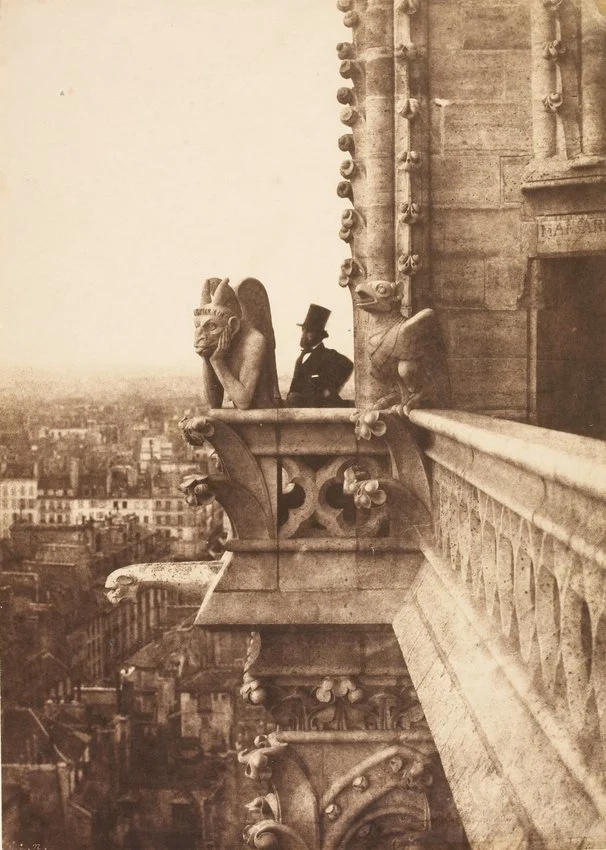
Charles Nègre, Le Stryge (Henri Le Secq at Notre-Dame), c. 1853. Public domain · Musée d’Orsay, Paris.
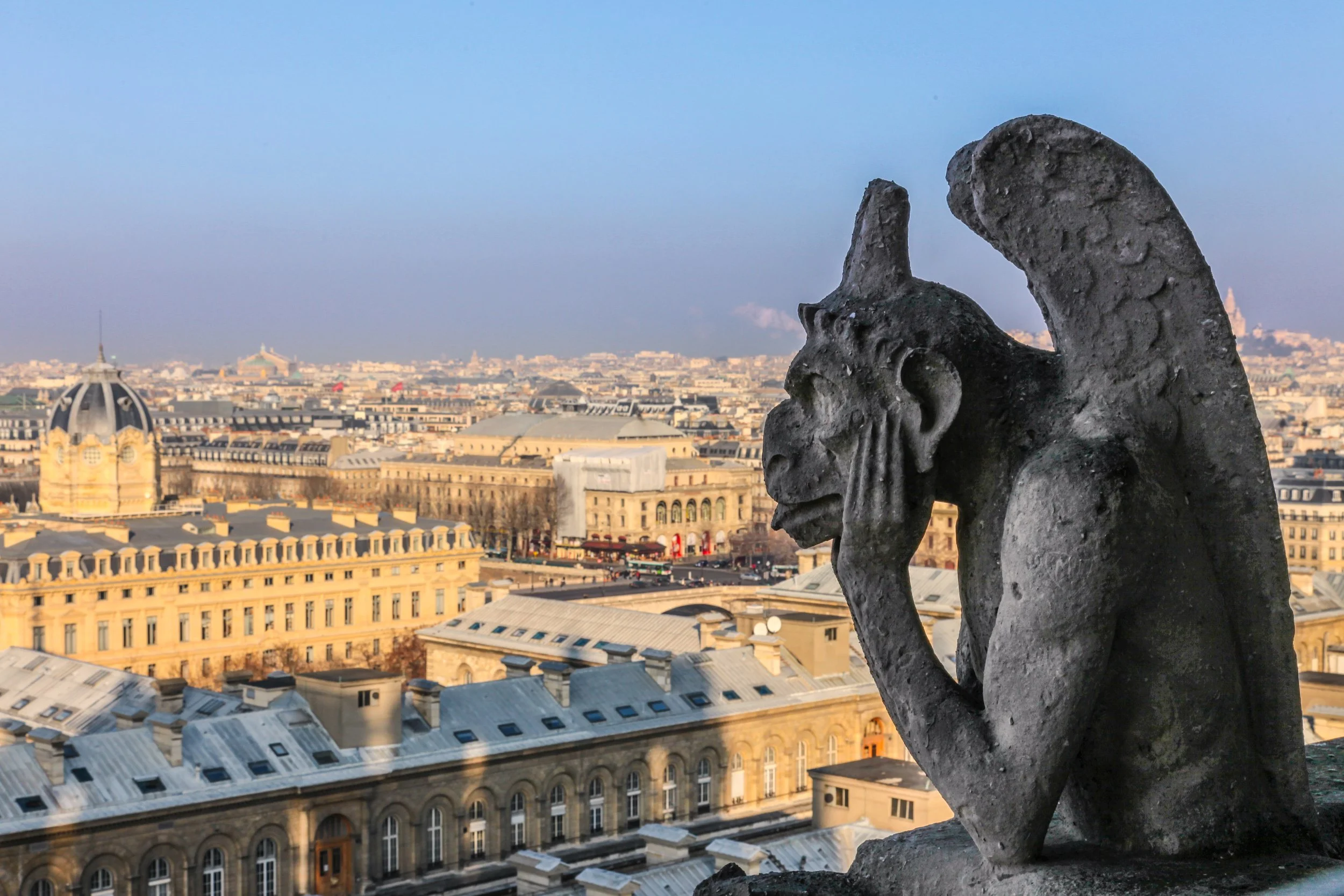
Le Stryge, Notre-Dame de Paris, 2009.
Photograph · William Riera
1980 · Santiago de Cuba
My connection with Paris started during my teenage years in my hometown of Santiago de Cuba, a city with its own French past. In the first years of the nineteenth century, thousands of refugees from Saint-Domingue landed in eastern Cuba, fleeing the revolution of 1791 that would create Haiti. They came from every class: planters with the people they held in slavery, and free Black and mixed-race families. Spain expelled many of them in 1809, but those who stayed settled the hills of Tivolí (inspired by Paris’s Jardins de Tivoli), planted coffee in the mountains above the city, and left behind family names, a French quarter and the Tumba Francesa, the drum and dance societies created by enslaved and free Black francophones and now recognized by UNESCO. In Santiago the French were the refugees and the strangers.
In 1980, in eighth grade, I joined a foreign language study club. French language and culture were the focus of our weekly meetings at the Círculo de Interés de Francés, where we started learning the language from scratch as an extracurricular activity. At my school the required language was English, not Russian as in many schools in Cuba back then, so French was something I chose. I was hooked from the start by the nasal sounds of the language, and by the first songs I learned, Alouette and Au clair de la lune, which to this day I still catch myself singing. But what meant the most to a boy starting to dream about traveling the world was browsing the school library and the club’s books about France and its culture. In one of them there was a photograph of a stone figure at the top of Notre-Dame, resting its chin in its hand and looking out over the roofs of Paris. For years I simply called it “the gargoyle.” Only later did I learn its name, Le Stryge.
1990 · Alliance Française, Santiago de Cuba
In the summer of 1990 I graduated with the highest honors in Computer Systems Engineering. I had lived in Havana since 1985 and never wanted to return to Santiago de Cuba, but the country was entering a very dark time. The Berlin Wall had fallen the year before, the Soviet Union was coming apart, and Cuba was sliding into what would be called the Special Period. Going back home seemed safer and wiser. So I returned, leaving behind a vibrant city where I had learned to free myself from the provincial mentality I had once escaped. My days in Santiago were ordinary, and in many ways boring. It was then that I enrolled in the French program at the Alliance Française, where I studied for more than a year, until graduation. “La Alianza,” as I used to call it, became an oasis of culture and connections in a city where I felt out of place. Through books, films and music I came to know Paris long before I dreamed of setting foot in Charles de Gaulle. I listened to Mireille Mathieu, one of the first French singers I learned to love, and many years later, in 2025, I saw her sing at L’Olympia in Paris. I read parts of Les Misérables in French, and Hugo’s Paris still connects me with the city. And I watched Jacques Demy’s Les Parapluies de Cherbourg (1964) so many times, trying to learn its dialogue, that I could follow much of it by heart. In that film every line is sung.
II · Rue Campagne-Première
Walking early: patience and return
Before the city woke up, a man with a heavy wooden camera was already at work. Eugène Atget, born in 1857, had been a sailor and a struggling actor before he turned to photography in his forties. From 1899 until his death in 1927 he lived at 17 bis rue Campagne-Première, in Montparnasse, and the sign on his door said what he believed he was making: Documents pour artistes, documents for artists. Painters, set designers and city archives bought his prints. Almost nobody thought of him as an artist himself.
For three decades he walked the same old streets, mostly early in the morning, when the light was soft and the sidewalks were empty. He went back to the same corners year after year: a shop window, a courtyard, a stairway, the iron sign of a wine merchant. His Paris has almost no people. As on Daguerre’s boulevard, the crowd is missing, but this time the photographer chose the hour. Atget was not wandering. He was returning, again and again, to the old city that Haussmann had spared and that the new century was still taking away.
A few doors down the same street, at number 31 bis, Man Ray had his studio. In Atget’s empty streets and shop-window mannequins he saw the dream city the Surrealists were looking for, and in 1926 some of the pictures appeared in their magazine, La Révolution surréaliste. As Man Ray told the story, the old man asked him not to put his name on them. They were only documents.
Man Ray’s assistant, a young American named Berenice Abbott, first saw Atget’s prints in the studio in 1925. She went to meet him, and in 1927 she made his portrait, shortly before he died. The next year she and Julien Levy bought what was left of his archive. Abbott took it to New York and spent forty years making his name, until the Museum of Modern Art acquired it from her in 1968. The first section of the archive at the end of this page, Le vieux Paris, follows that rescue.
Walter Benjamin understood what Atget had found. In his short history of photography he wrote that Atget’s deserted streets had been photographed like the scene of a crime: a place where something has happened, and only the evidence remains. That is the first lesson of this walk. The flâneur does not see a street once. He comes back, early, until the street shows him what is leaving it.
I may have walked past rue Campagne-Première without seeing it. It runs a few steps from the boulevard I took to the cemetery, and when I watch it now on a screen I recognize it, but nothing in my photographs says I was there. Atget went back to the same streets for thirty years; I passed his once without looking. This November I will go back to it, early, the way he did.
From the archive · Le vieux Paris: Atget and the vanishing city →
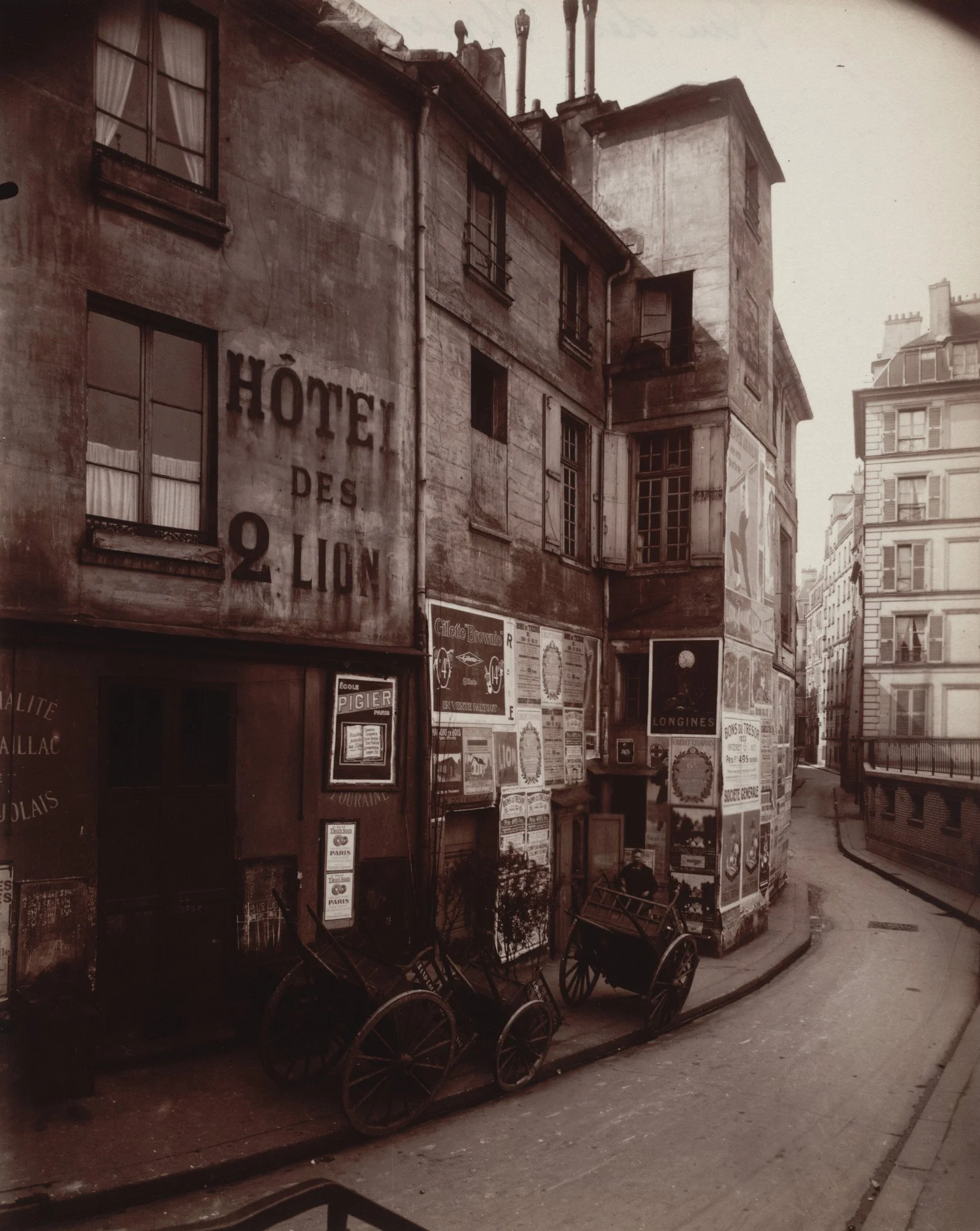
Eugène Atget, Rue des Ursins, April–May 1923. Albumen silver print.
Public domain · The Museum of Modern Art, New York, Abbott-Levy Collection
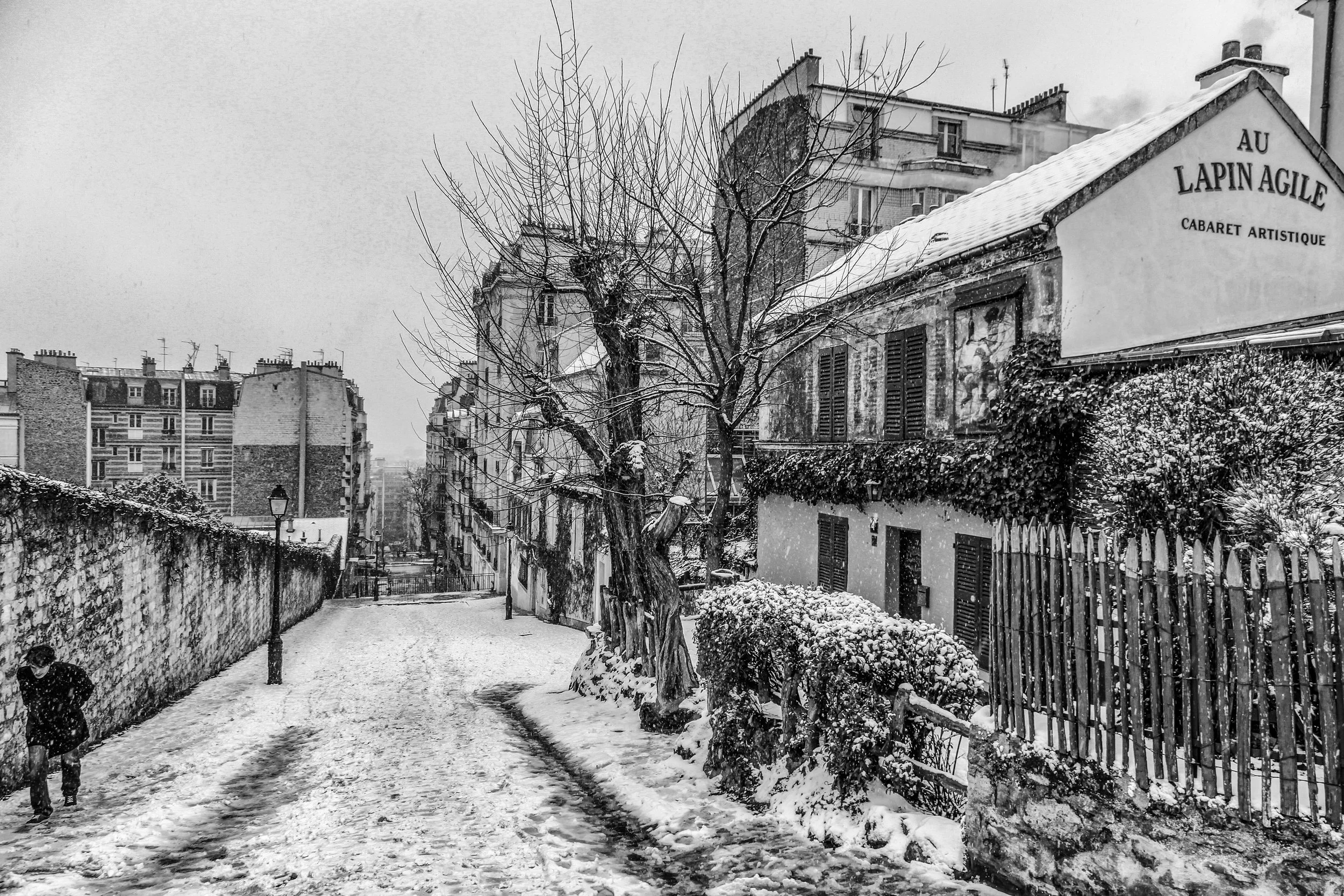
Au Lapin Agile, Montmartre, January 2009. Atget photographed the same cabaret in 1922.
Photograph · William Riera
1995 · North Miami Beach
In 1995 I came to live in Miami as an immigrant. Most Cuban newcomers settled where Spanish was spoken everywhere, but my family lived in North Miami Beach, where I heard English, Creole, Yiddish and Russian more often than Spanish. One day my sister-in-law took me to a Haitian community center for advice about finding work. My English ran out quickly, so most of my conversation there was in French. In Santiago, French had come with the refugees. In Miami, I was the one who had just arrived. Around mid-1996, since data processing and software were my strength, I found an entry-level job at a company in Aventura, replacing a Québécoise woman who was going home to Quebec. She trained me, and our conversations often slipped from English into French.
That first year I did not drive or own a car, so I kept the habit I had brought from Cuba: a sharp curiosity about the city around me. I got lost in Miami on purpose, riding its sparse public transportation just for fun or walking through neighborhoods like Downtown and Miami Beach. A year later, when I started to drive, I felt I already knew the Miami where my life was taking place.
My new life began to take over. I moved to North Beach, in Miami Beach, and enrolled in an English program at college. French stayed with me through its music, which kept me connected to the Paris I had learned to love from afar.
III · Boulevard du Montparnasse
Walking at night, walking by chance
When the streetlights came on, another kind of walker went out. Gyula Halász had come to Paris in 1924 from Brassó, in Transylvania, to work as a journalist. He took the name of his hometown and became Brassaï, “the one from Brassó.” At night he walked the fog of the quays, the cafés and the markets of Les Halles, the dance halls and the streets where the police and the prostitutes knew each other by name. Henry Miller, who walked with him, called him the eye of Paris.
Brassaï carried a tripod and waited. Night photography meant long exposures, and he is said to have timed some of them by the length of a cigarette. In 1932 he published Paris de nuit, a book of fog, cobblestones and lamplight that made the dark city as famous as the bright one. The more secret night stayed in his drawers for decades: the brothels, the opium smokers, the women dancing together at Le Monocle. He published it only in 1976, as The Secret Paris of the 30’s.
Another Hungarian had arrived a year after him. André Kertész came from Budapest in 1925 and found his people at the Café du Dôme, on the Boulevard du Montparnasse, where artists from half of Europe met. Kertész photographed by chance and by tenderness: a fork resting on a plate, the quiet studio of Mondrian, a shadow on a stairway. He is often credited with encouraging Brassaï to pick up a camera. In 1936 he left for New York, and in the autumn of 1963 he came back to photograph Paris once more.
What the two shared was a foreigner’s eye. They saw what Parisians had stopped noticing, because nothing in Paris was ordinary to them yet. They also trusted chance, the lucky accident the Surrealists called objective chance: the corner turned without a plan, the face that appears in the fog. Walking at night and walking by chance ask for the same discipline. You go out without knowing what you will find, and you stay long enough for it to appear.
I have never sat at the Dôme. I know the Boulevard du Montparnasse only on foot and in daylight, on my way to the cemetery in 2016 and again in 2024: the cafés of Kertész on one side of my walk, and at the end of it, the graves of the people I had come to visit.
From the archive · Paris la nuit: Brassaï, Kertész and the years between the wars →
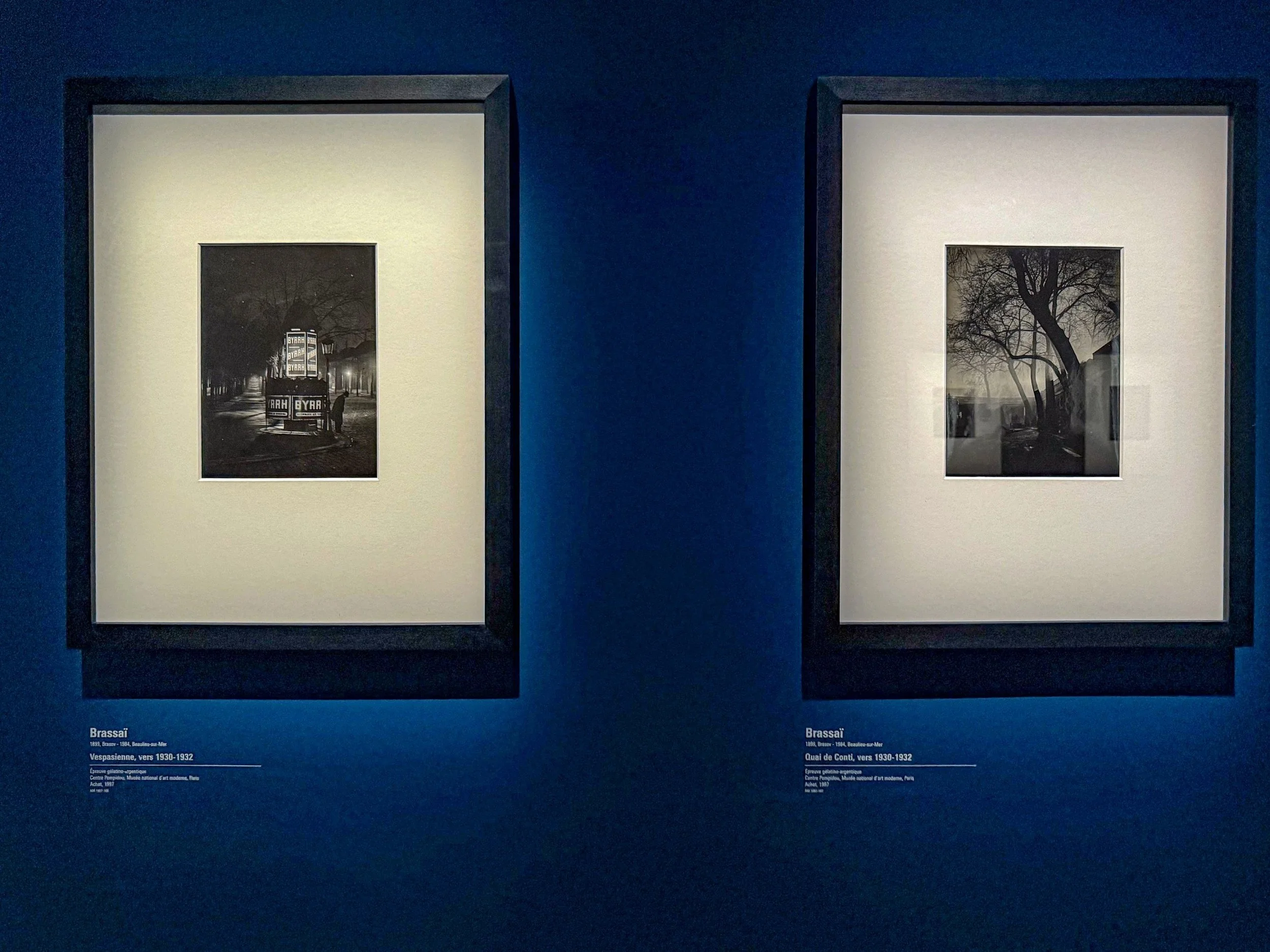
Brassaï, Vespasienne and Quai de Conti, about 1930–32, in Surréalisme, Centre Pompidou, Paris, 2024.
Installation view · Photograph · William Riera
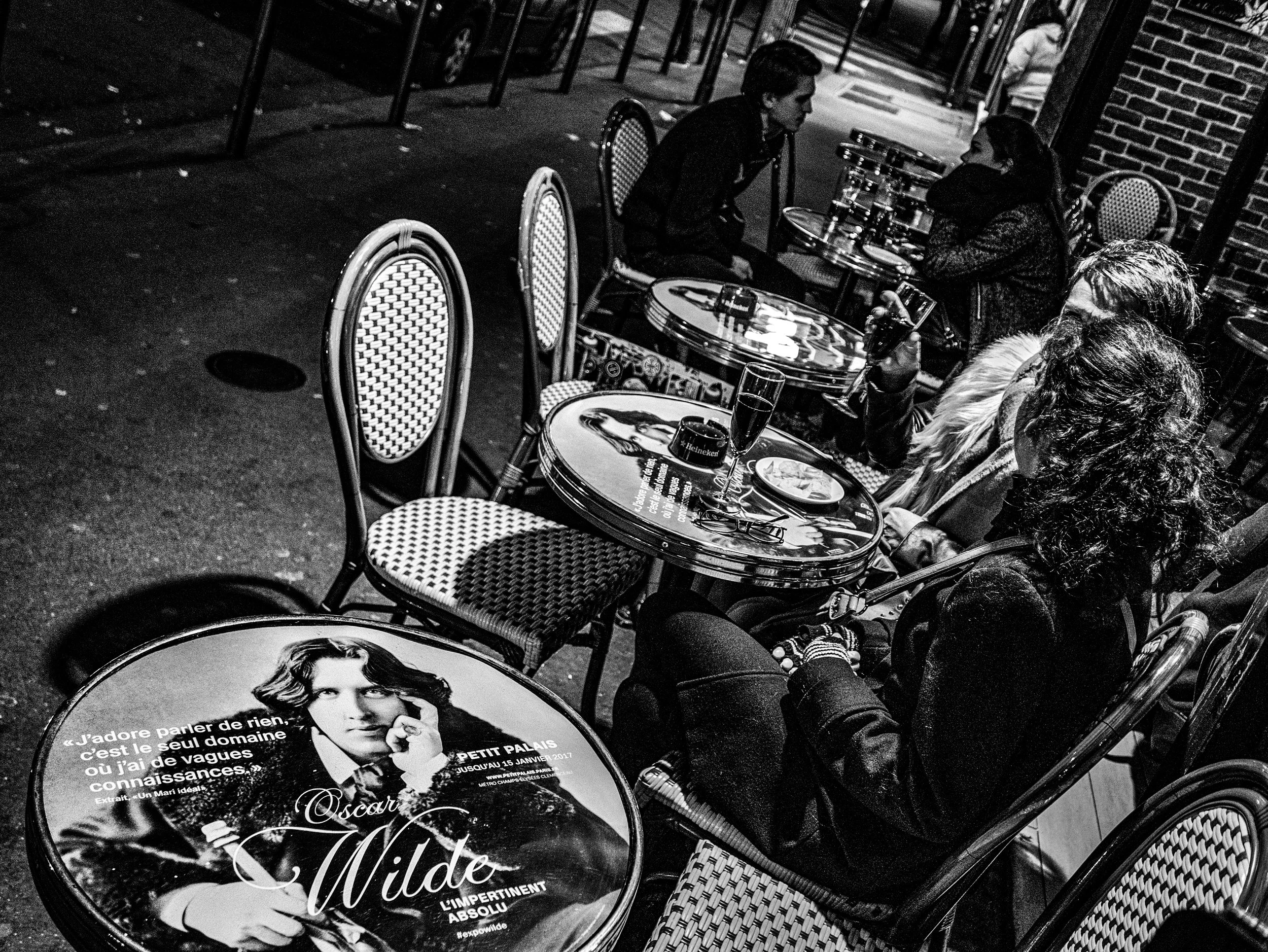
A café in Montmartre, Paris, November 2016.
Photograph · William Riera
2004 · Portbou – Cerbère
Around 2000, I was already working as a developer of web business applications for Miami’s local government IT department, and curiosity about web and graphic design took me back to college. I enrolled in graphic design classes, but soon switched to photography, once I realized that making images moved me in a way that designing on a computer did not. That was the beginning of my adventure as a photographer, and of long hours in the darkroom at Kendall Campus.
In the fall of 2004 I traveled to Europe for the first time. I entered through Spain, and Barcelona, with its Catalan culture, Gaudí and Dalí, became the first page of a journey that has not stopped since. My last name, Riera, is Catalan: a stream. In Figueres, after the Dalí museum, my curiosity took me up the town’s hill to the Castell de Sant Ferran. There were only a few visitors and some of the site’s staff, and the visit felt like a meditation. I was taken by the views, and it was the sight of the Pyrenees, so close, that made me ask a security guard how to get there. From Figueres it was easy, he told me: a train to Portbou, and from there another to Cerbère, the first French town across the border. I did not hesitate. I was anxious, excited and a little scared, crossing into France with nothing but my camera bag. At Cerbère I went through a check, opened a door, and stepped onto French soil for the first time, surrounded at last by French people.
From the train I took a few photographs. For years I set them aside: the view was ugly and industrial, rail yards and warehouses, nothing worth keeping. Many years later, when I began to study image theory, I learned about Walter Benjamin: his life, his ideas, and his death at Portbou in 1940, fleeing the Nazis. Only then did I understand that on my first European journey I had passed through the same town, in the opposite direction. I went back to those photographs, and the place where Benjamin died was there, in pictures I had thought were not worth looking at. Benjamin called it the optical unconscious: the camera keeps more than the eye takes in at the moment. Those images had waited, like a latent image on film, until I knew how to develop them. That short train ride holds a small but important place in my memory.
IV · Place de l’Hôtel-de-Ville
When the walk became a postcard
In 1950 Life magazine asked Robert Doisneau for photographs of lovers in Paris. One of them shows a young couple kissing as they walk past the Hôtel de Ville, with the café tables and the passers-by blurred around them. It looks like a moment caught on the run. In 1986 it became a poster, and soon it was the most reproduced picture of the city, on postcards, calendars and mugs. When strangers came forward in the early 1990s claiming to be the lovers, and went to court, the truth came out: the couple were two young drama students, Françoise Delbart and Jacques Carteaud, and the kiss had been staged for the camera.
After the war, Doisneau, Willy Ronis, Izis, Édouard Boubat and Sabine Weiss pictured a tender, crowded, working Paris: children in the street, lovers on benches, bistros, dances on the fourteenth of July. Their photographs were generous, and the world loved them. Exhibitions like The Family of Man, at the Museum of Modern Art in New York in 1955, carried that warmth across the world. Without anyone planning it, their Paris became the city’s brand.
Walter Benjamin had seen it coming. He wrote that the flâneur ends up in the department store, where walking turns into shopping. The humanist street became merchandise: a feeling of Paris you could buy and hang on a wall. The walk had become a postcard.
What the postcard left out was just as real. In the same years, on the edge of the city, Algerian workers lived in shantytowns like the one at Nanterre. On 17 October 1961 the Paris police attacked a peaceful march of Algerians protesting a curfew imposed on them alone; dozens were killed, some thrown into the Seine, and historians still debate how many. Few of the beloved photographs of Paris show any of this. Élie Kagan was one of the photographers who did. Lucy Sante’s The Other Paris, kept in this archive, tells the story of the city the postcard edited out: the poor, the street, the people pushed to the edges.
None of this makes the humanist photographers liars. Their tenderness was real. But a photograph can be true and staged at the same time, generous and partial at the same time, and the walker who loves Paris has to carry both.
The first time I stood in front of the Hôtel de Ville, in January 2009, the city had turned the square into an ice rink, and Parisians skated where Doisneau had once posed his lovers. When I passed by again at the end of October 2025, the building itself had become an image. Shepard Fairey had covered its façade with a monumental face, a red tear under each eye, and four words: Respect, Earth, Resist, Unite. It marked ten years of the Paris climate agreement. Standing there, I remembered that my own country was leaving that agreement for the second time: Trump had ordered the withdrawal on his first day back in office, and it would take effect a few months later. The square that gave the world its most famous postcard was now carrying a message of its own.
From the archive · La photographie humaniste: the postwar city of the humanist photographers →
2006 · Paris, a layover
After crossing into France in 2004, I needed to see Paris with my own eyes. At the end of 2006 I planned to spend the last days of the year in Madrid, welcome 2007 there, and fly home after el Día de Reyes. On purpose, I booked my flight to Madrid with a layover of more than ten hours in Paris. My plan was simple: get to l’Étoile, walk the Champs-Élysées, and live the Parisian life, even if only for a few hours. And so I did. Walking, I felt like a child finally seeing the places from the books he used to get lost in. My eyes kept matching each place with the one I had saved in my memory for years. Then I climbed to the top of the Arc de Triomphe, and the city opened all around me. I finally understood why the place is called l’Étoile: twelve avenues leaving the arch like the points of a star, and Paris spread out in every direction. It was magnificent. I had seen the whole city from above; learning to see it from the street would take me years. But that day I stayed up there a few minutes longer, to thank my mother. Her name was Estrella, Étoile in French. “Here I am,” I thought, “a boy born of one Étoile, standing on top of another.”
V · Place Blanche
Walking close
Some photographers stopped watching from a distance and walked into the scene. Robert Frank, a young Swiss photographer, spent long stretches in Paris between 1949 and 1952, years before The Americans. His Paris is gray, quiet and personal, closer to a diary than to a postcard.
The Dutchman Ed van der Elsken arrived in 1950 and fell in with the young bohemians of Saint-Germain-des-Prés, who had no money and stayed up all night. He photographed them from inside their circle, not as a visitor. In 1956 he published Love on the Left Bank, a story told in photographs around Vali Myers, a red-haired Australian dancer. The American William Klein, who had come to Paris in 1948, brought the same nerve to the street: wide angles, grain and blur, faces pushed against the lens.
The Swede Christer Strömholm went furthest. From the late 1950s he lived for about a decade around Place Blanche and Pigalle, among young trans women, many of whom worked the streets to pay for the surgery they wanted, at a time when the police treated them as outlaws. He photographed them in hotel rooms, in bars and on the sidewalk, and he called them his friends. The book of those years, Vännerna från Place Blanche, The Friends from Place Blanche, appeared only in 1983, more than twenty years after he began.
Walking close brings risks that walking at a distance does not. For the photographer it is a question of nerve. For the people photographed it can mean exposure: to the police, to their families, to strangers who will look at them for decades. His student JH Engström carried the close, diary-like way of seeing into our time with Sketch of Paris (2013). For SoFLaFoto, whose project Picturing Queerness in the Americas works with images of people who have often been looked at without being asked, these questions are not history. They are the work.
In November 2016 I stayed one block from the Moulin Rouge. Place Blanche, across the boulevard, did not stop me: it is a crossing of traffic and tourists now, and nothing there recalls the women Strömholm photographed. What held my eye was the next two blocks, alive with neon: Supermarché érotique, Porno Shop, La Diva promising a private table-dance show, Star City with its sauna, hammam and lounge bar. People came and went from the shops, some of them selling erotic souvenirs, and I was surprised to see a woman walk into one with her daughter. I photographed the signs. The night Strömholm lived from the inside now advertises itself in lights.
From the archive · Les étrangers: the outsider’s eye, from 1949 to today →
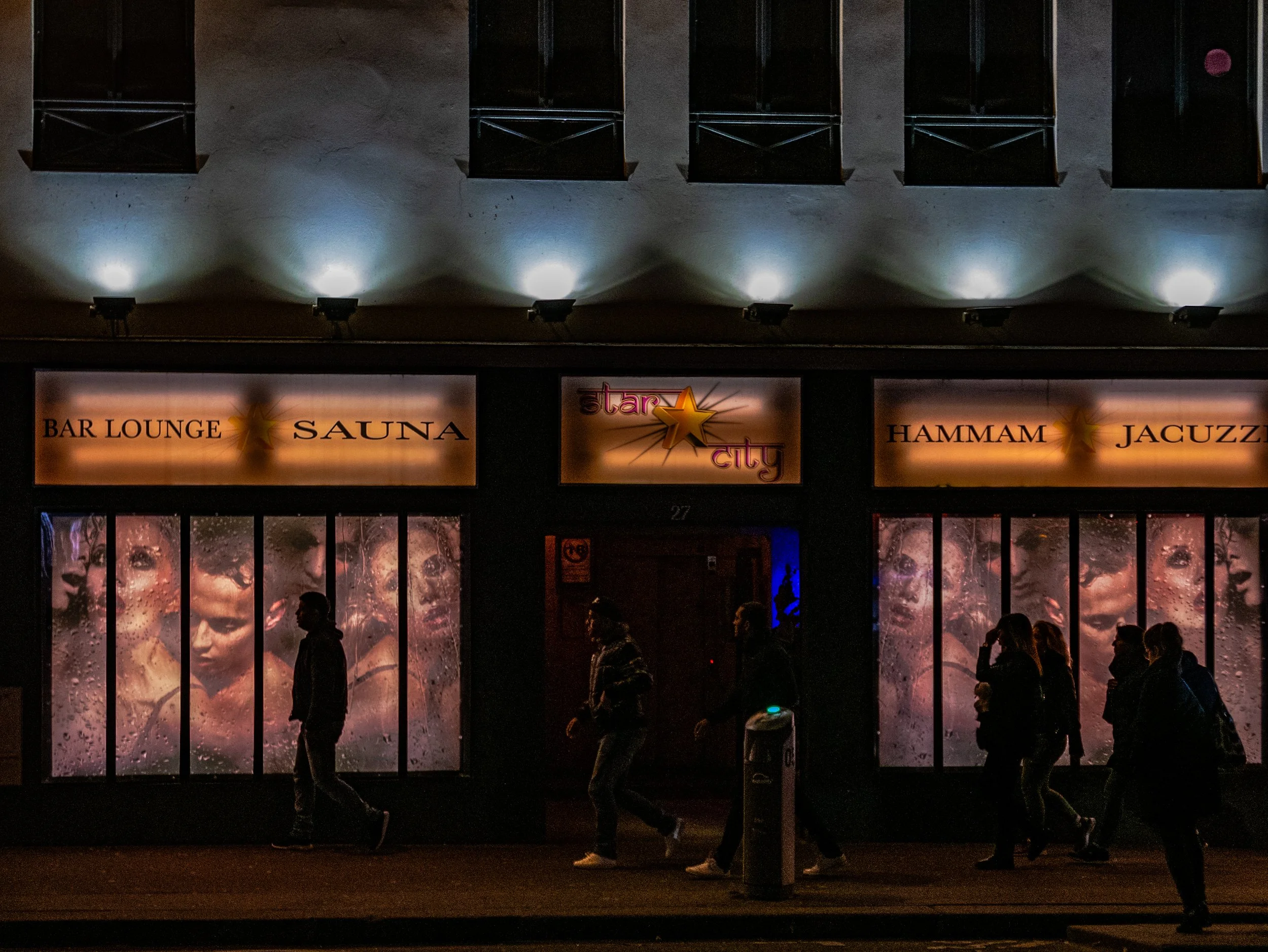
Star City, Pigalle, November 2016.
Photograph · William Riera
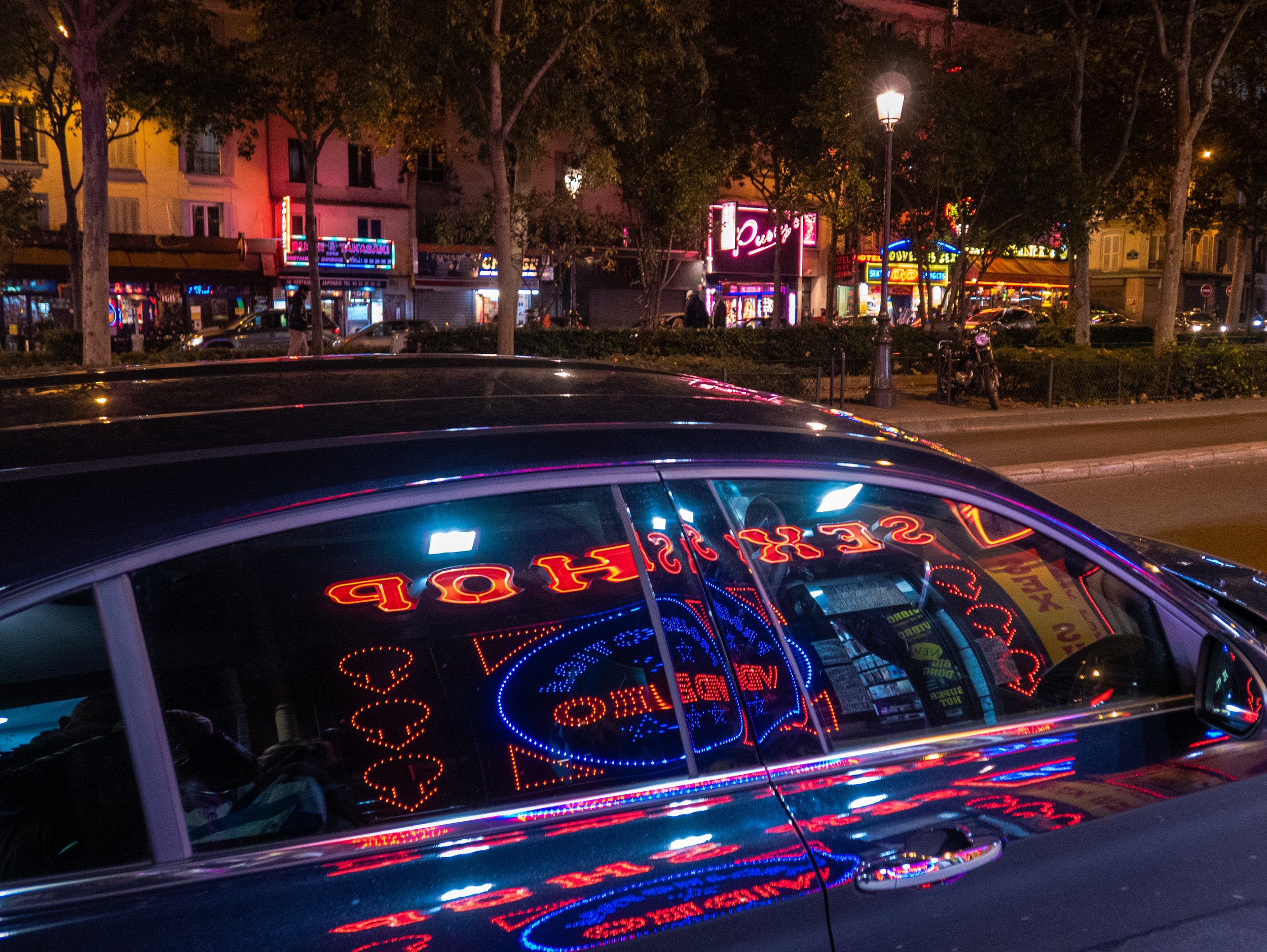
Sex shop signs reflected in a car window, Pigalle, November 2016.
Photograph · William Riera
2016 · Paris Photo
By 2016 I was no longer just a man walking with a camera. Two years earlier, after several years photographing the streets of Miami and other parts of the world, I had organized my first exhibition. It took place in an unconventional art space, but it marked the beginning of my immersion in Miami’s art scene, and of a serious commitment to learn about photography as an art medium and image making as an art practice.
This year, I decided to finally spend some days in Paris. I did not want to walk the city as a tourist; I wanted to live it as a Parisian. I also wanted to attend Paris Photo for the first time, the largest international fair dedicated to photography. Riding the Métro to Montmartre, to my room a block from the Moulin Rouge, I found the corridors filled with Richard Avedon’s photographs, enormous. The RATP, in partnership with the Bibliothèque nationale de France and its exhibition La France d’Avedon, had hung his images in eleven stations: film portraits, dancers in motion, Avedon’s Paris. I could not help it: I started photographing the people passing by those giant images, catching their reactions. I had just arrived, and I already knew these days would be my graduation as a flâneur.
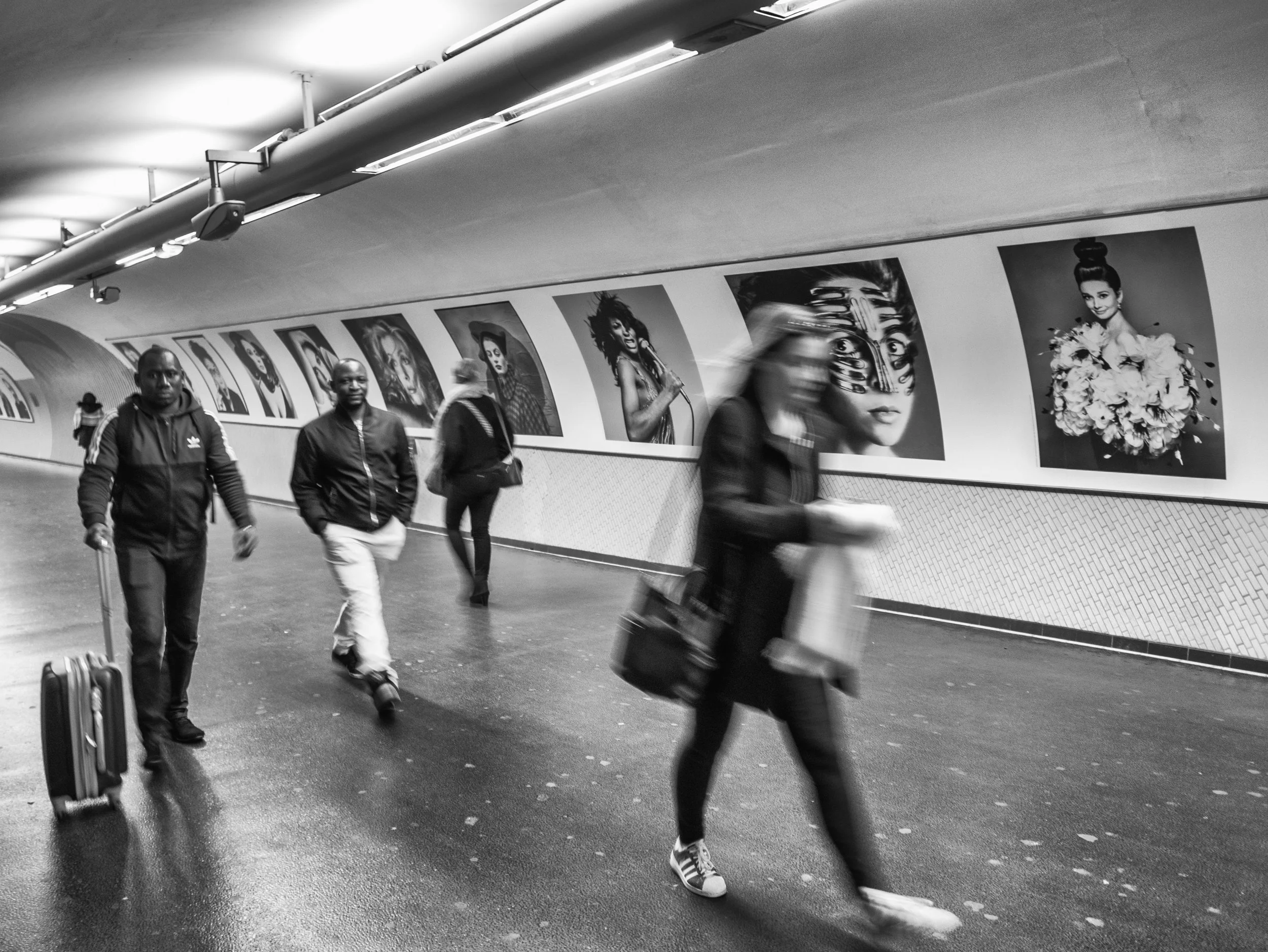
Richard Avedon’s photographs in a Paris Métro corridor, La RATP invite, 11 November 2016.
Photograph · William Riera
I gave one full day to the fair: the galleries, the book presentations, and the ocean of photographs on the walls of the Grand Palais. Back then the publishers shared the same floor as the galleries, not a floor of their own as they do now. I had planned to see Joel Meyerowitz present Cape Light, and I did. But there was another presentation I had not known about. Agnès Varda, the filmmaker and flâneuse par excellence, whose husband Jacques Demy had made one of the films I learned French from, was presenting a book of the photographs she made in Cuba in 1962–63. I met her, and she dedicated my copy of Varda / Cuba. A French artist who had walked my country with a camera was signing her pictures of it for a Cuban in Paris. The day could not have been better.
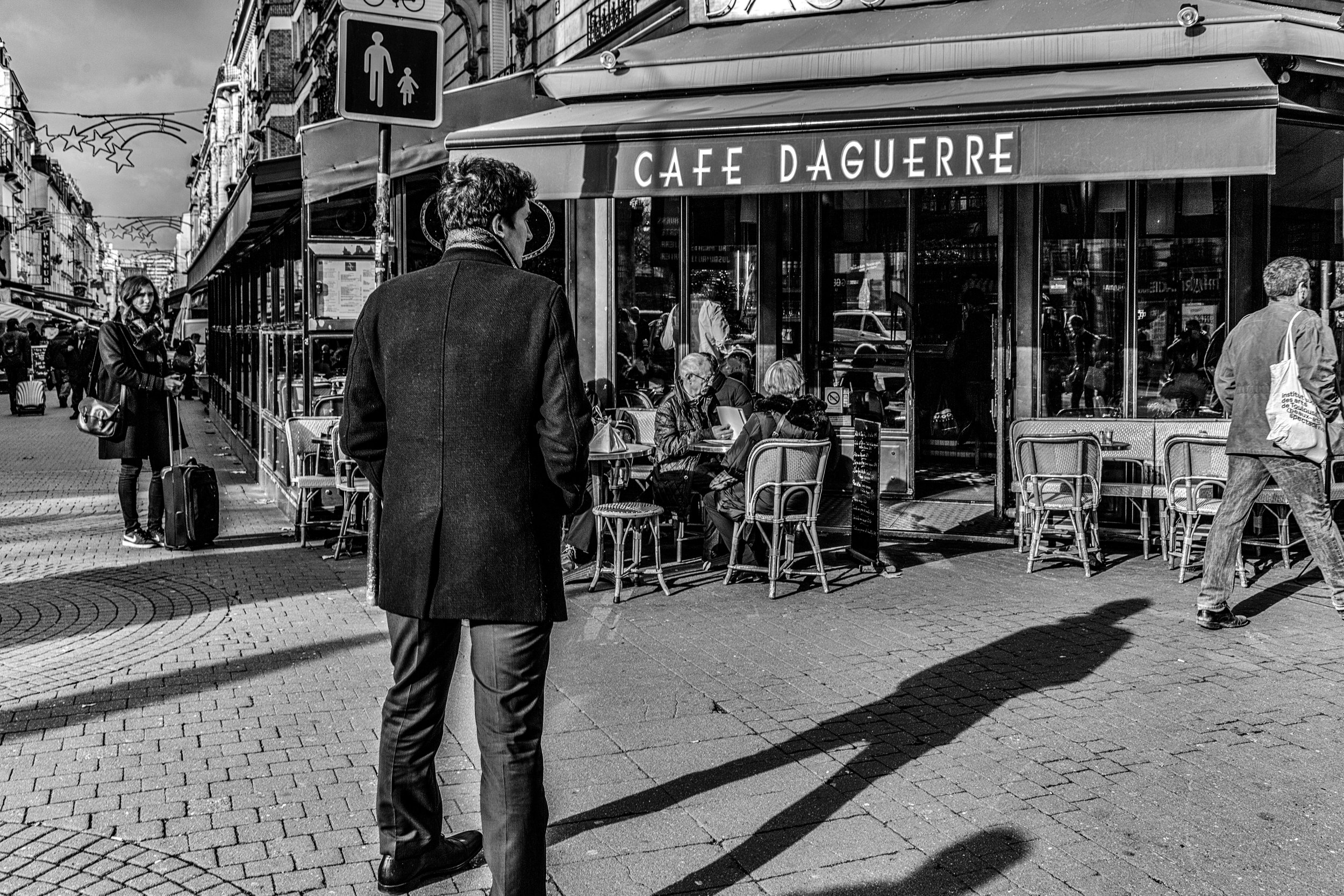
A man walking past the Café Daguerre, Paris, November 2016.
Photograph · William Riera
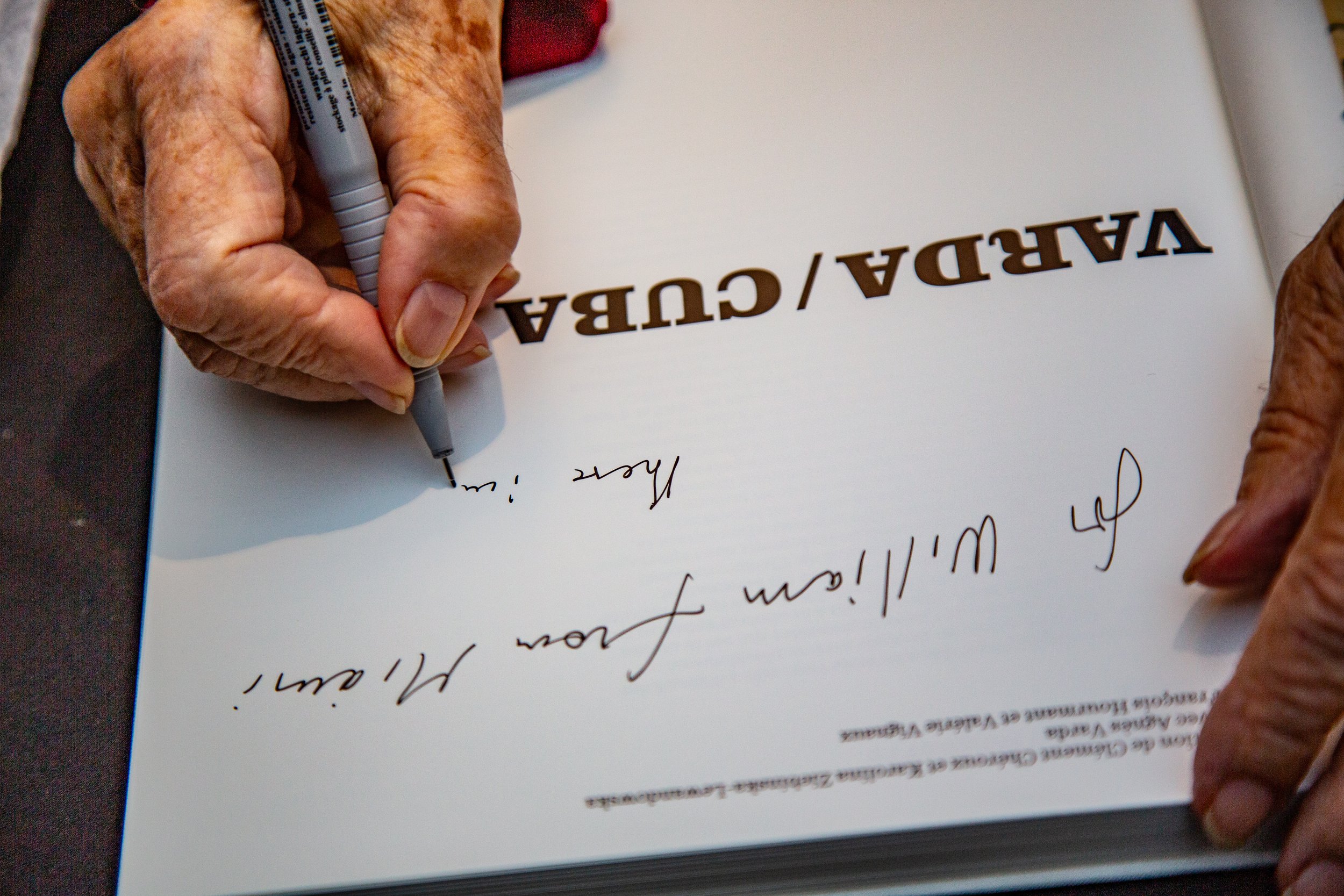
Agnès Varda dedicating Varda / Cuba, Paris Photo, Grand Palais, November 2016.
Photograph · William Riera
VI · Île Saint-Louis
The flâneuse and the flâneur
The tradition from Baudelaire to Benjamin pictures one figure: a man alone in the crowd, free to look without being looked at. In 1985 the sociologist Janet Wolff asked the obvious question: where were the women? In the literature of modernity, she argued, the flâneuse was invisible. A woman alone in the street was read as lost, or for sale, never as someone who was looking.
Women walked anyway, and some of them carried cameras. Agnès Varda began as a photographer before she made films. In Cléo de 5 à 7 (1962), a young singer walks through Paris for two hours while she waits for the results of a medical test. At first the city looks at her. By the end, she is the one looking. It is one of the great walks in the history of cinema, and it gives the flâneuse her place in Paris.
Julio Cortázar, who lived in Paris from 1951 until his death, gave two Latin American versions of the walk. In his story “Las babas del diablo,” a French-Chilean translator and amateur photographer, wandering the Île Saint-Louis one November morning, takes a picture of a woman and a boy. Only when he enlarges it does he understand what he saw. Michelangelo Antonioni turned the story into Blow-Up (1966). Years later Cortázar and Carol Dunlop spent thirty-three days on the highway from Paris to Marseille, stopping at every rest area along the way, and wrote Los autonautas de la cosmopista (1983): a journey made slow on purpose, a walk at the speed of a car.
The flâneuse has her historians now, among them Anna María Iglesia Pagnotta, whose La revolución de las flâneuses tells her story in Spanish. She also has her heirs. Varda is the precedent that makes Yolanda Andrade, a Mexican street photographer who calls herself a flâneuse, part of a lineage and not an exception. Her walking book, Caminando por Londres, sits on my shelf. In this chapter the flâneuse is also the elder and the teacher, and the flâneur learned part of his way of looking by walking beside her.
When I began my life in photography and image making, I never connected with the groups, in person or online, where technique and equipment were the main conversation. I wanted programs on the theory of the image and on art criticism, and what I considered a serious conversation about the image as contemporary art. Outside New York, I could not find anything close to home that offered it. Around 2017 I learned about the programs led by the Cuban-born art critic and educator Juan Antonio Molina through Página en blando, then based in Mexico City and now in Querétaro. In its online classes and workshops, taken from Miami, I had the privilege of learning from some of the leading Mexican and Latin American photographers. One of them was Yolanda Andrade, who taught me about street photography, flânerie and the making of a photobook. In 2021, on a visit to Mexico City, we finally met in person at the school. Since then we have become friends who look for cities where we can meet and walk together: Mexico City, Miami, Paris and, most recently, Los Angeles.
In 2024 one of my reasons for going back to Paris Photo was to see Yolanda’s photographs on the walls of the Grand Palais, in Dissident Fantasies, an exhibition of four Latin American women artists presented by Galería Memoria of Madrid. Between the fair and the streets, the flâneuse and the flâneur walked Paris together. We walked the Champs-Élysées, the avenue I had first seen from the top of the Arc eighteen years before, this time at street level, beside my teacher. We crossed to Saint-Germain-des-Prés, stopped for coffee at the Café de Flore, and followed the long boulevards until the day ended in the Parc Monceau. There, side by side, we made two different photographs. I went to the beauty of the park itself: the greenery, the falling leaves, the way their colors answered one another. Yolanda brought people into hers, and with them, a story.
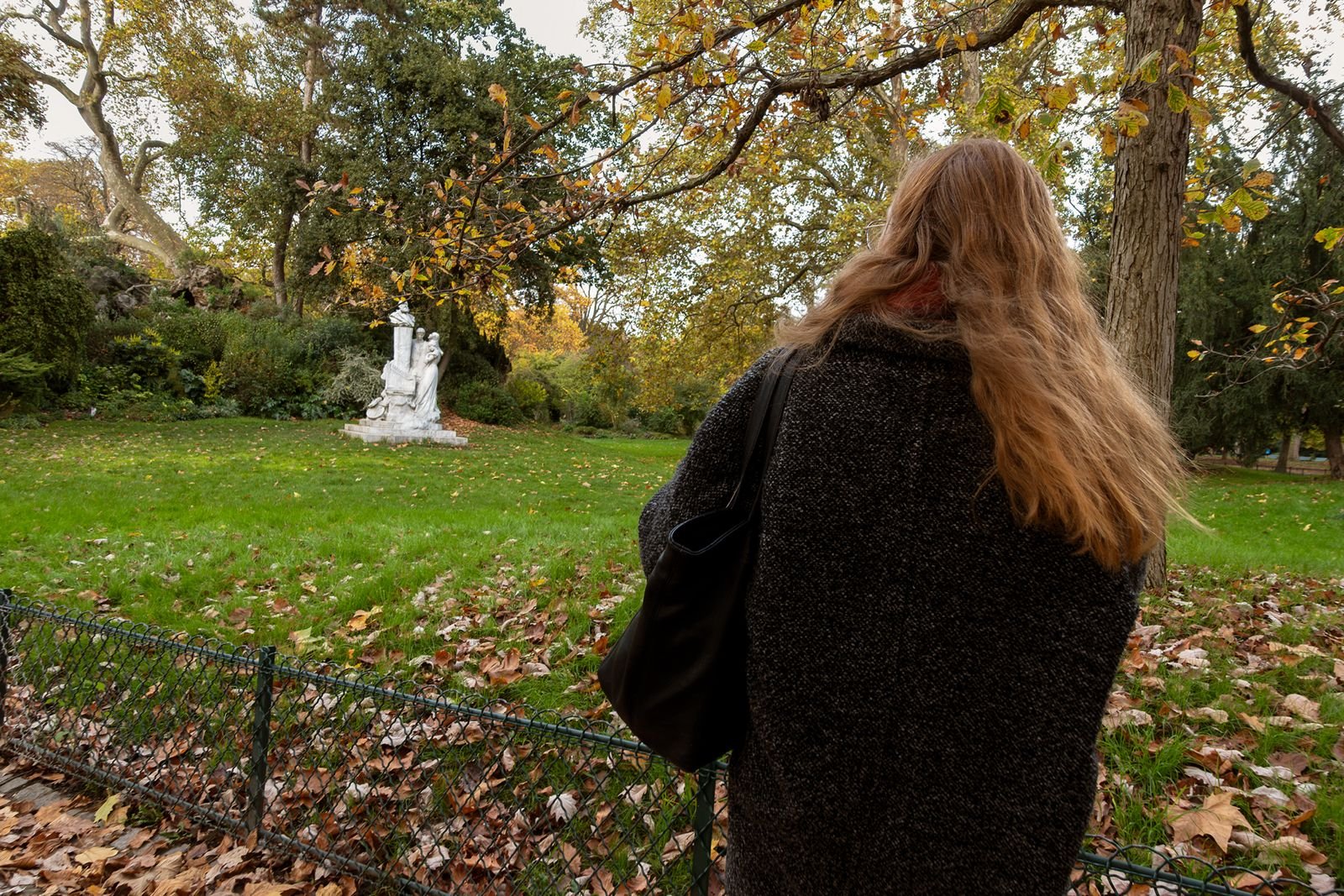
Yolanda Andrade, Parc Monceau, Paris, 2024.
With the artist’s permission · Yolanda Andrade
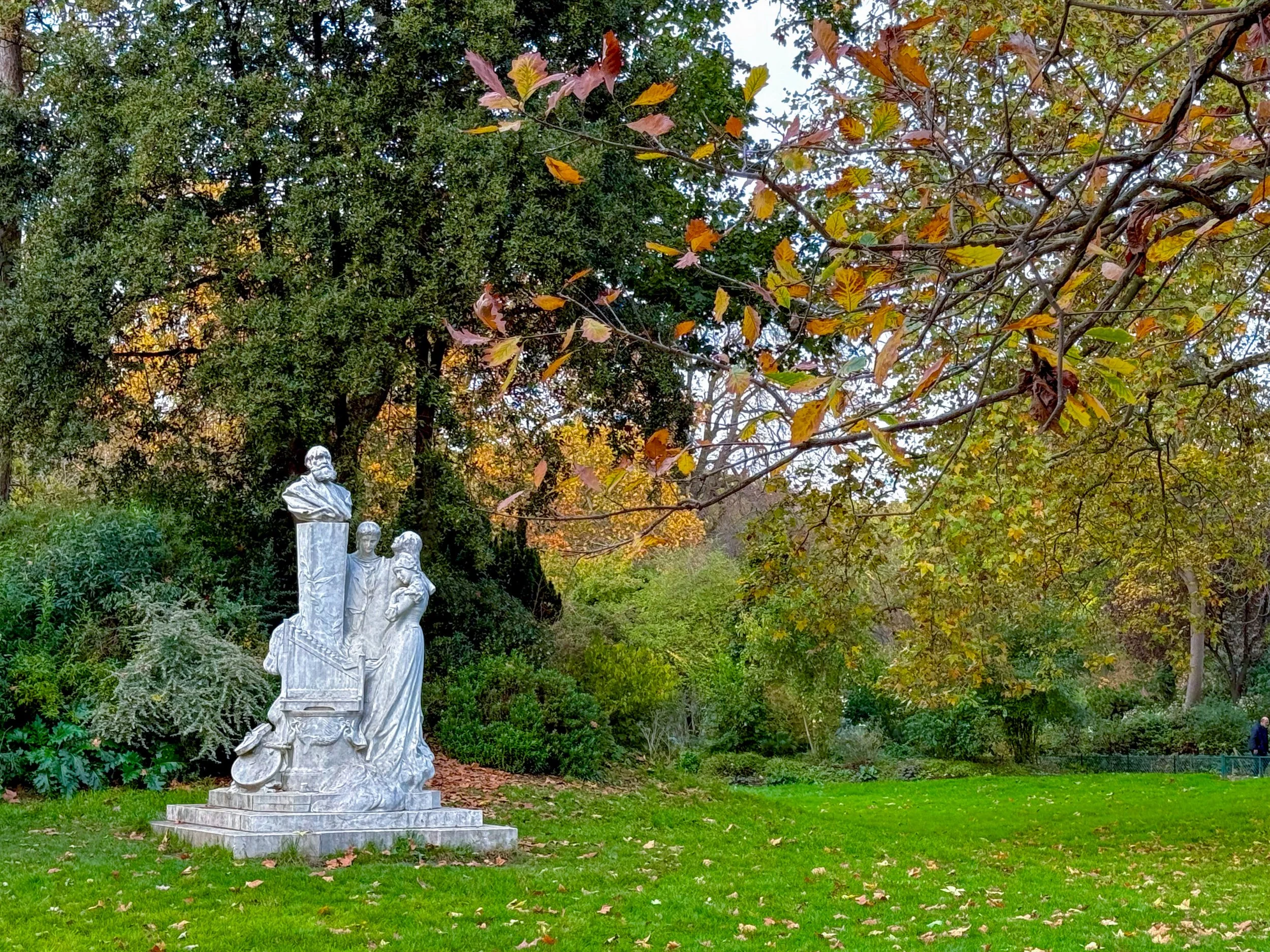
William Riera, Parc Monceau, the same day, 2024.
Photograph · William Riera
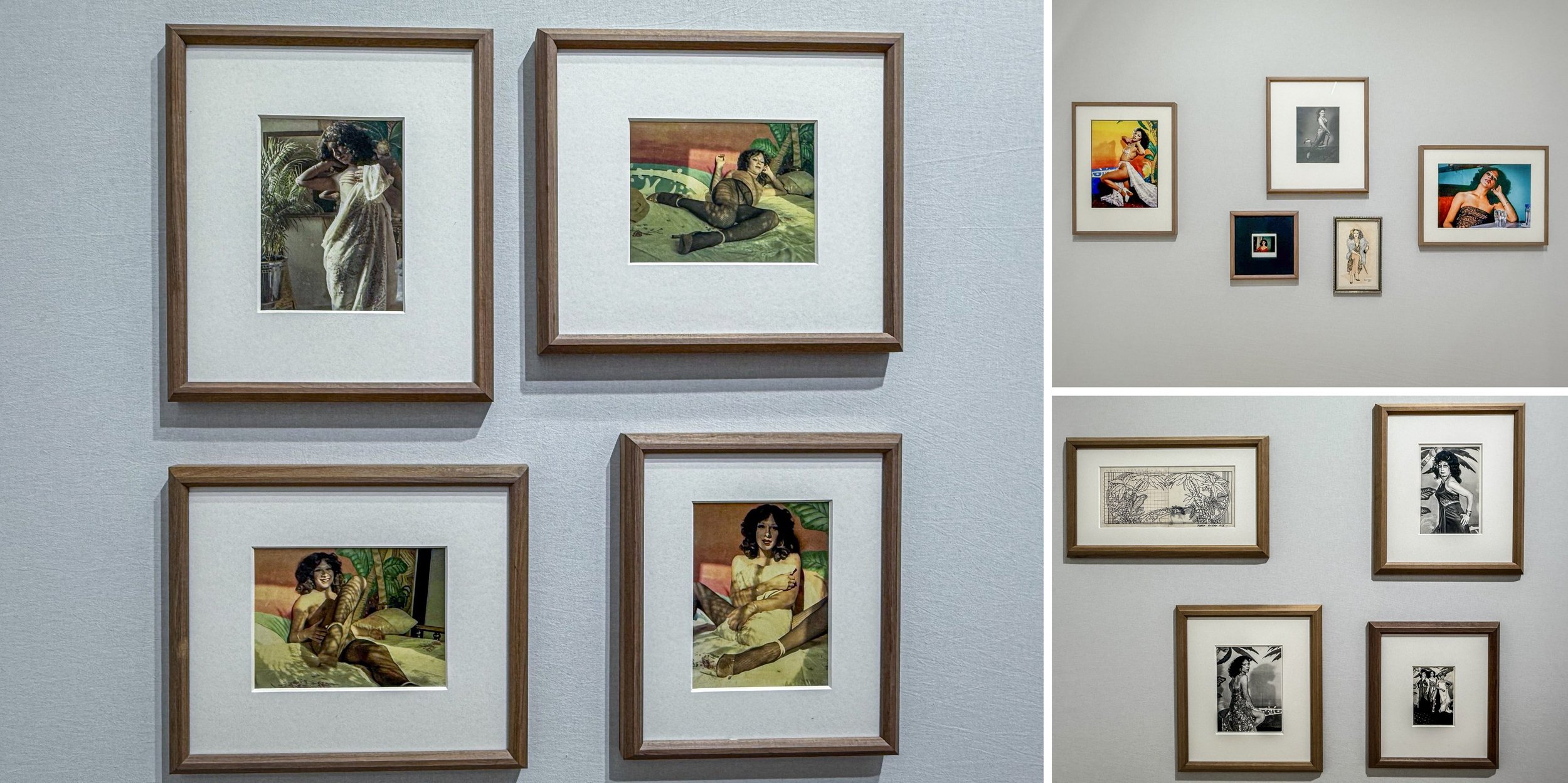
Yolanda Andrade’s photographs of Terry Holiday, with works by Holiday, in Dissident Fantasies, Galería Memoria (Madrid), Paris Photo, Grand Palais, November 2024.
Installation view · Photograph · William Riera
VII · Avenue Winston-Churchill
Walking among images
Two stops close this walk, and they could not be more different. The first is a city where nothing moves. Steps from the Boulevard du Montparnasse, behind a long stone wall, lies the Montparnasse cemetery. César Vallejo, the Peruvian poet who once imagined his own death in Paris on a day of rain, is buried there. For a flâneur, a cemetery is the most patient walk of all.
I have a habit I keep in some of the cities I visit: I go to its cemeteries, and I come back with photographs. I have made them in La Recoleta in Buenos Aires, the Cementerio de Colón in Havana, Novodevichy in Moscow and Mount Auburn in Cambridge, and at home, in Miami’s Lincoln Memorial Park. For me a cemetery is more than a resting place. It is a book of art and history, where I learn the stories of individual lives and the urban legends that grow around them, and a place where I stop to think about my own life. Paris has three I keep going back to: Père-Lachaise, Montmartre and Montparnasse. I walked Montparnasse in 2016 and again in 2024, and walking its paths is like walking through the people in this essay: Baudelaire is buried there, and Man Ray, and Susan Sontag, and Agnès Varda with Jacques Demy, and Julio Cortázar with Carol Dunlop.
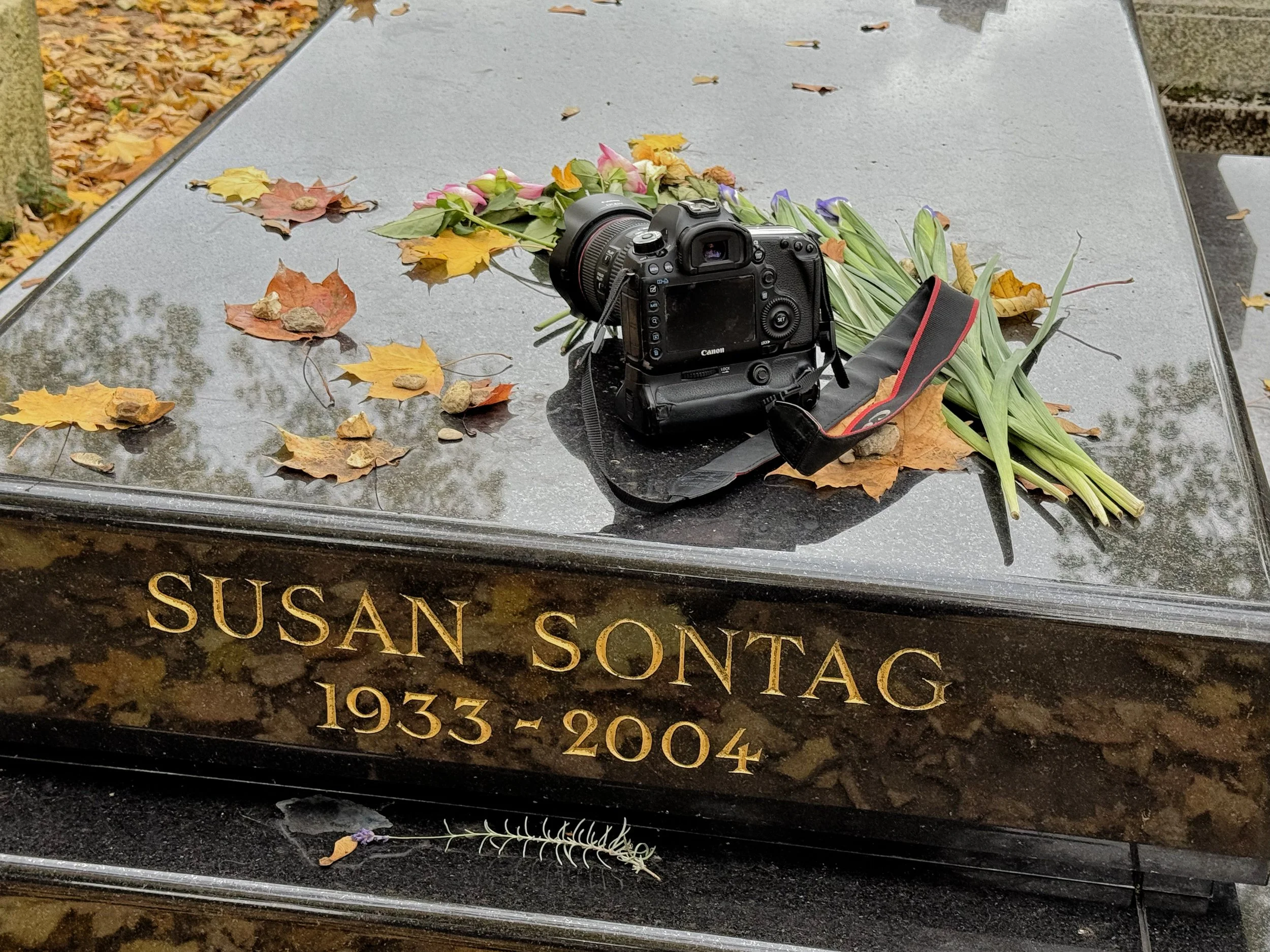
Susan Sontag’s grave, with my camera, Montparnasse cemetery, 2024.
Photograph · William Riera
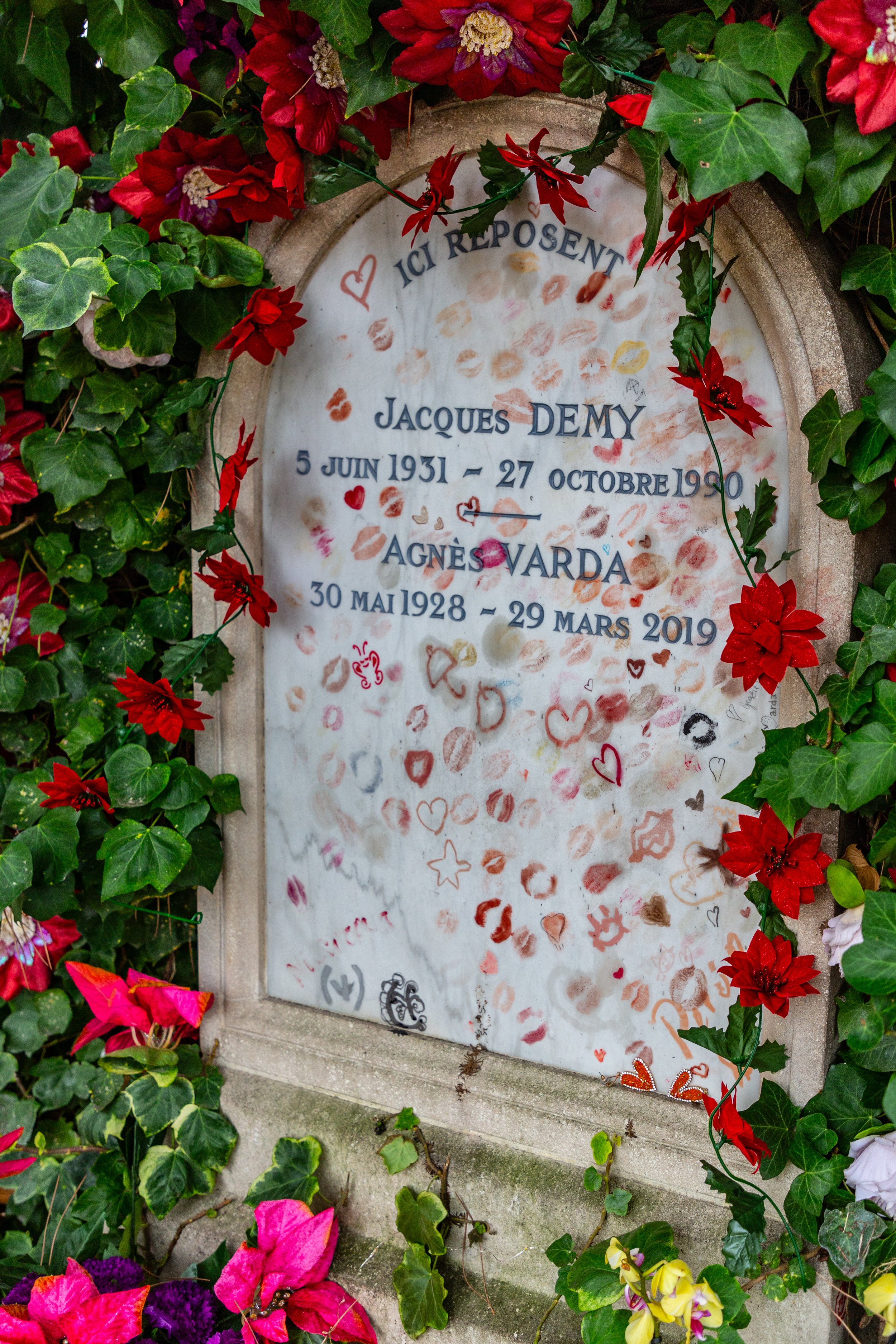
Agnès Varda and Jacques Demy’s grave, Montparnasse cemetery, 2024.
Photograph · William Riera
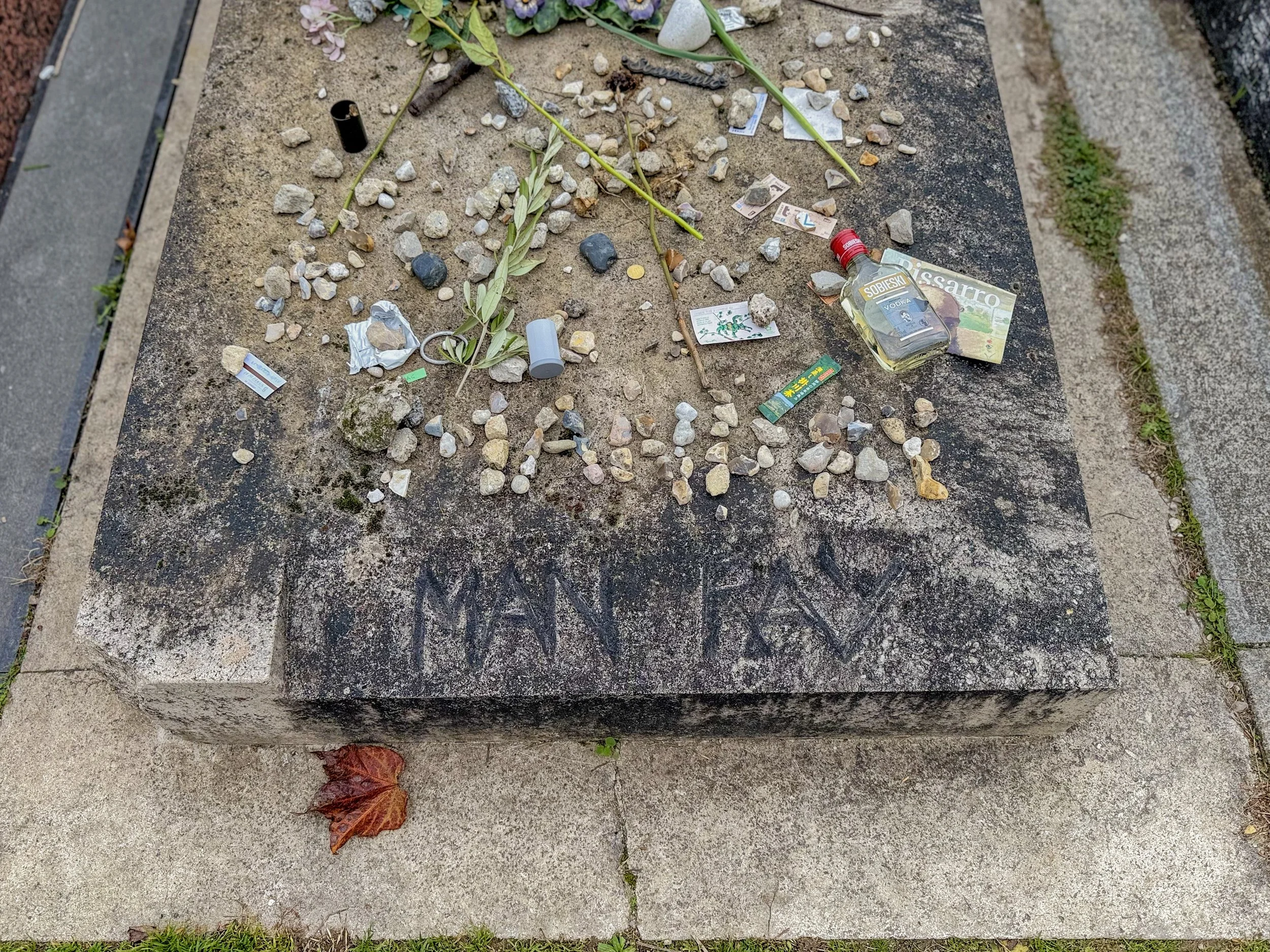
Man Ray’s grave, Montparnasse cemetery, 2024.
Photograph · William Riera
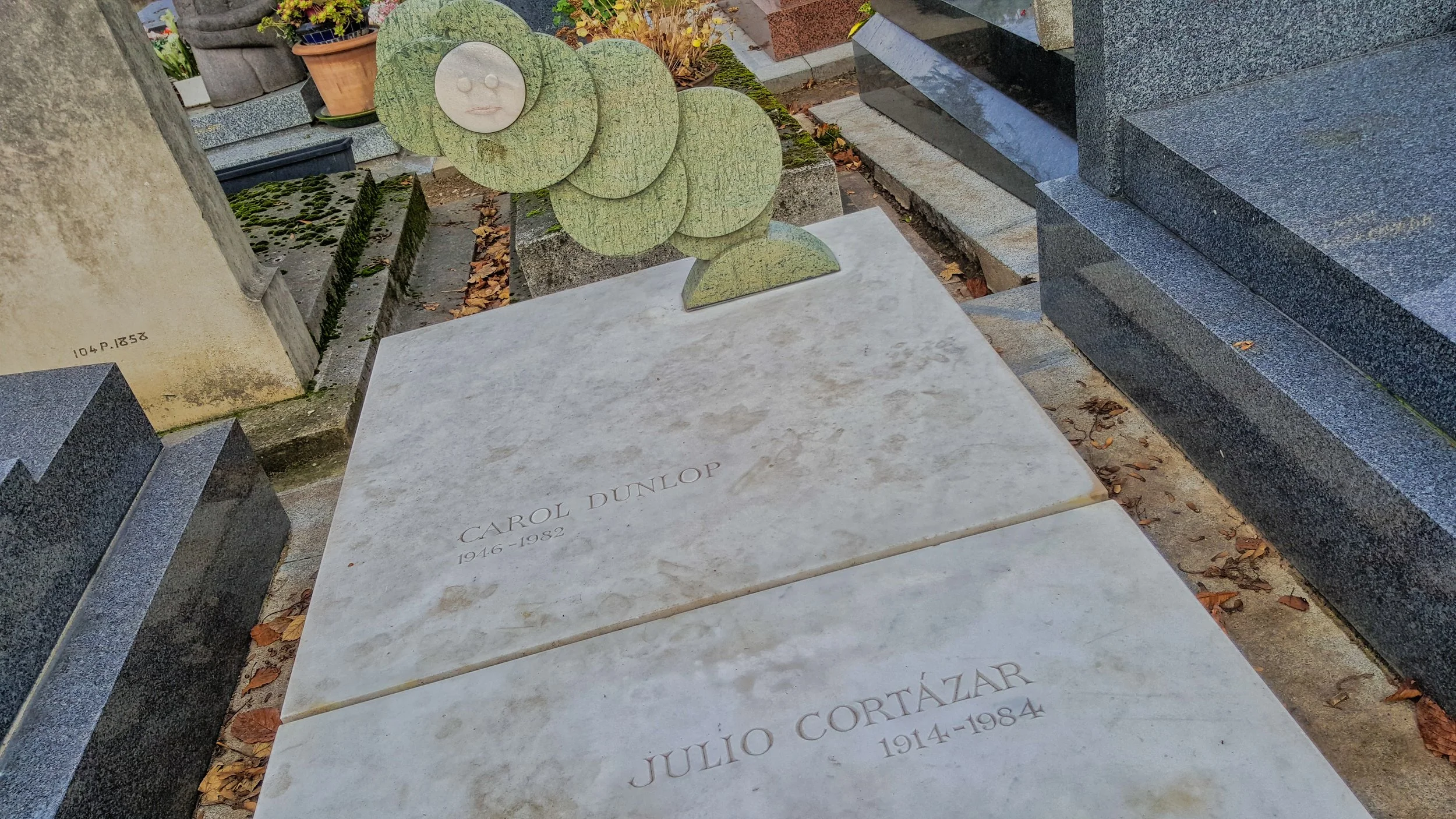
Julio Cortázar and Carol Dunlop’s grave, Montparnasse cemetery, 2016.
Photograph · William Riera
The second stop is the opposite: a palace full of images, almost all of them for sale. The Grand Palais was built for the World’s Fair of 1900, and Walter Benjamin called the world’s fairs places of pilgrimage to the commodity, where crowds came to look at things they could not yet own. Paris Photo, founded in 1997, moved under the palace’s glass roof in 2011 and returned in 2024, after years of renovation, the same year Yolanda’s photographs hung on its walls.
Walking the aisles of the fair is the arcade walk of our time. Booth after booth, images go by the way the crowd went by Daguerre’s camera, too fast to leave a mark. The flâneur’s old rule, to look without owning, is tested at every step. This year the fair opens on 12 November, as France celebrates two hundred years of photography. I will be there, and so will she.
This year I will walk those aisles with a purpose of my own. I go to Paris Photo representing SoFLaFoto, and my task is to look for Latin American voices in a fair where they are still few: of some 250 exhibitors, about a dozen come from Mexico City, Buenos Aires, São Paulo, Bogotá and Caracas. They are there if you look. Galeria Leme, from São Paulo, brings Luiz Braga’s photographs of the Amazon, its equatorial light and its everyday life. The Los Angeles gallery ROSEGALLERY shows the Mexico City photographer Tania Franco Klein, whose book Mercado de Sonora I bought from that same gallery and keep in SoFLaFoto’s Mexico Fotolibro Archive; this time she brings RAGE™, a series on how emotion is shaped and sold by media and power. Finding those voices, and carrying them back to Miami, is the walk I came to take.
I was writing the last sentences of this essay when November arrived. It was past midnight, and I had not noticed October ending, or how close my days in Paris had come. In France it is already La Toussaint, the day of all the saints; in Mexico, the Day of the Dead is beginning. Yolanda is already there. She arrived earlier this week, and her last message to me said: “Llegué ayer y hoy con jet lag. Mañana empiezo con mis flâneries.” As I write this, she is out walking.
The man who lands in Paris this time is not the one who came in 2016 to graduate as a flâneur. He comes back with more cities behind him, a shelf of Paris books, and a teacher walking ahead of him.
I think again of the Boulevard du Temple in 1838: the man who stopped to have his boots polished, the bootblack bent at his feet, the two of them staying in the picture while the crowd vanished. Flânerie, I have learned, is two arts at once: to keep walking, and to know when to stop. In a few days the flâneuse and the flâneur will walk Paris again. I do not know yet where we will stop, or what will stay. That part comes after the walk. Come with us.
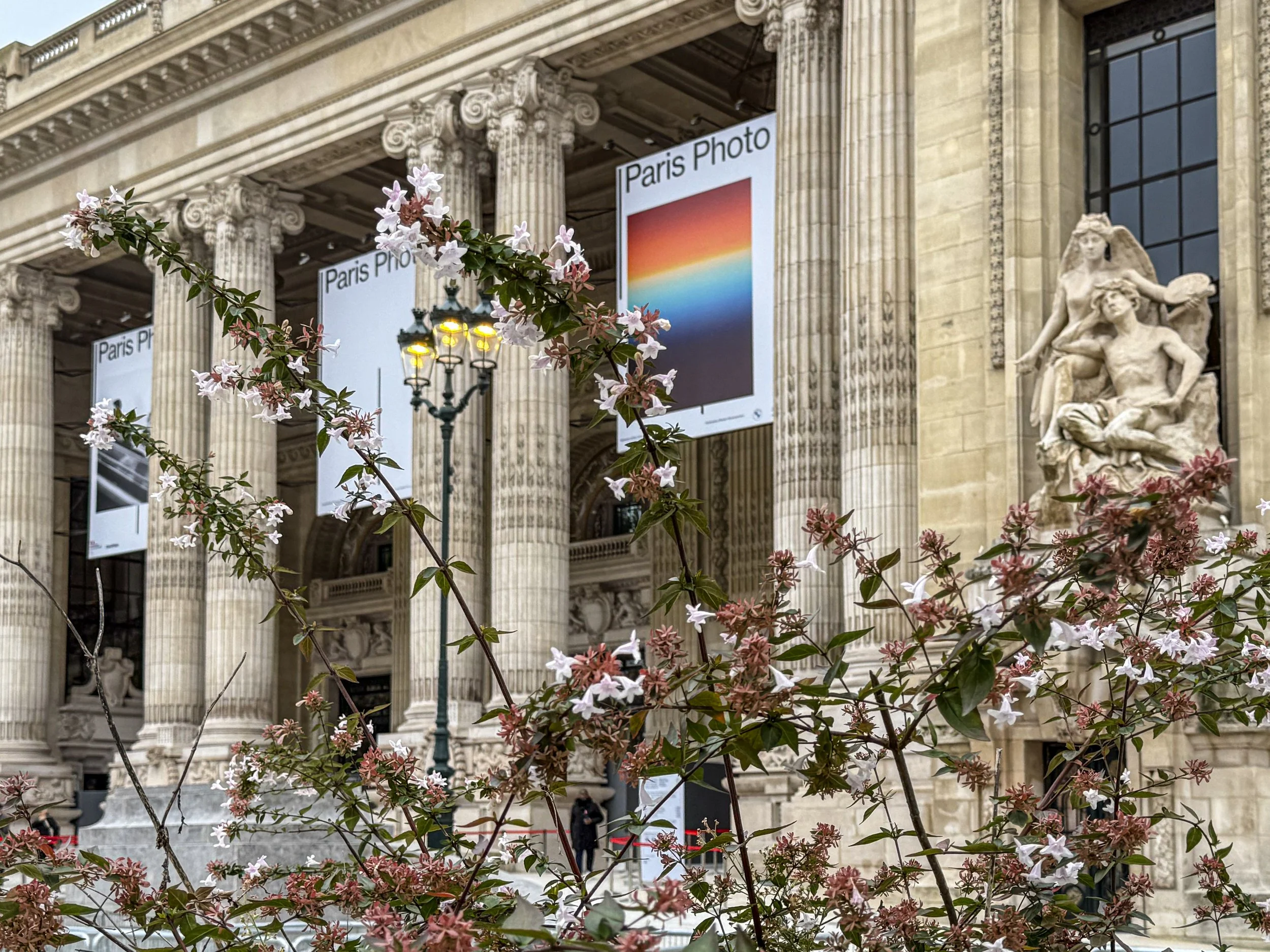
Paris Photo, Grand Palais, November 2024.
Photograph · William Riera
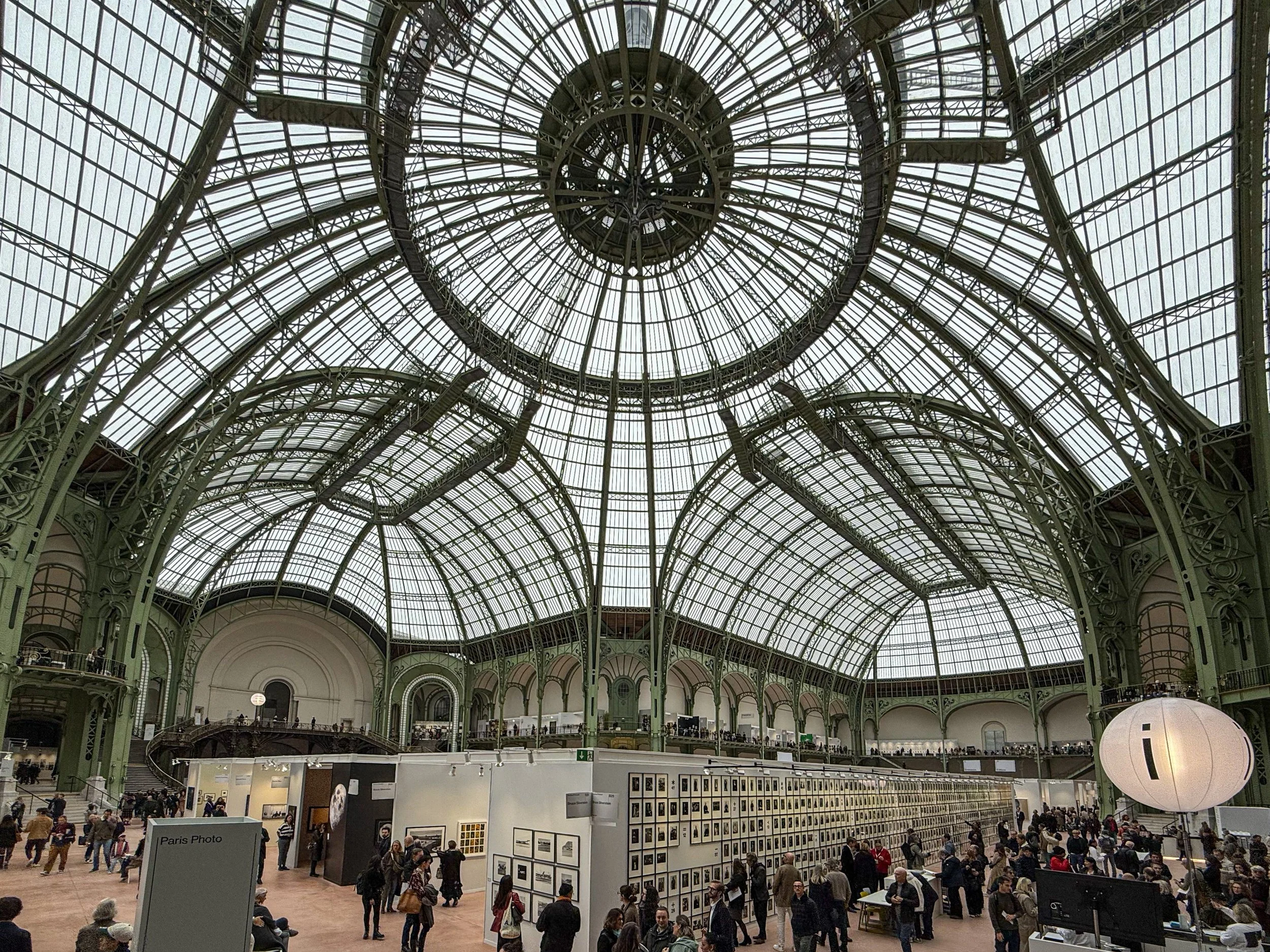
The fair under the glass roof of the Grand Palais, November 2024.
Photograph · William Riera
Épilogue · Paris, novembre 2026
After the walk
This page will continue after the walk, in late November 2026.
William Riera (Santiago de Cuba, Cuba, 1967) is a Cuban American photographer and researcher based in Miami, whose work centers on the photobook and on photography from Latin America and its diasporas. He founded and directs the South Florida Latin American Photography Forum (SoFLaFoto), where he curates exhibitions and the Photobook Archives.
Language editing and structural feedback for this piece were supported by Claude (Anthropic).
From riera’s private library
Further reading
The essay’s sources, from Riera’s private library, same library as the photobooks below.
Benjamin and Baudelaire
Breve historia de la fotografía — Walter Benjamin · Casimiro Libros, 2011
La obra de arte en la época de su reproductibilidad técnica — Walter Benjamin · El Estilete, 2015
The Writer of Modern Life: Essays on Charles Baudelaire — Walter Benjamin · Belknap Press, 2006
Calle de sentido único — Walter Benjamin · Akal, 2015
Dialéctica de la mirada: Walter Benjamin y el proyecto de los Pasajes — Susan Buck-Morss · A. Machado Libros, 1996
Las flores del mal — Charles Baudelaire · Alianza Editorial, 2011
Walking
El arte de leer las calles: Walter Benjamin y la mirada del flâneur — Fiona Songel Clark · Barlin Libros, 2021
La revolución de las flâneuses — Anna María Iglesia Pagnotta · Wunderkammer, 2019
Hombres que caminan solos — José Ignacio Carnero · Literatura Random House, 2021
Bystander: A History of Street Photography — Colin Westerbeck and Joel Meyerowitz · Laurence King, 2017
The Mind’s Eye: Writings on Photography and Photographers — Henri Cartier-Bresson · Aperture, 2005
A Philosophy of Walking — Frédéric Gros · Verso, 2023
Caminar la vida — David Le Breton · Siruela, 2024
Caminando por Londres — Yolanda Andrade · edition of 50
Paris, Santiago and Cortázar
El populacho de París — Lucy Sante (published as Luc Sante) · Libros del K.O., 2018
Nuestras calles — Raúl Ibarra Albuerne · Editorial Oriente, 2017
Las armas secretas — Julio Cortázar · Cátedra
Rayuela — Julio Cortázar · Real Academia Española, 2019
Photobook Art Lab · Paris
Le Paris des flâneries
The 30 books about Paris from the founder’s library that accompany this essay now have a page of their own: Le Paris des flâneries, the Paris Photobook Archive.